BACnet Objects and Properties
BACnet Integration Solutions
Chipkin has BACnet solutions for almost every situation. We have over 20+ years experience in BACnet integration, check out our BACnet Products:
 CAS BACnet Explorer:
Available as a free tool for discovering, browsing, and testing BACnet devices.
CAS BACnet Explorer:
Available as a free tool for discovering, browsing, and testing BACnet devices.
BACnet devices organize all internal data using a structured object model. Each BACnet device exposes its data as a collection of objects, and each object is defined by a specific object type and a fixed set of properties. This object-oriented data model is fundamental to BACnet interoperability and allows devices from different manufacturers to be accessed in a consistent way.
Every BACnet device contains at least one object: the Device object. The Device object represents the device itself and provides identifying and operational information such as device instance number, vendor information, and supported services. All other objects represent measurable values, controllable outputs, or status indicators within the device.
BACnet Objects in Practical Terms
To understand how objects and properties are used in practice, consider a simple BACnet thermostat. Such a device may include a temperature sensor, a writable setpoint, a local/remote control selection, and a fault indication. Each of these functions is represented by a separate BACnet object.
For example, the measured room temperature may be exposed as an Analog Input object, while the heating or cooling setpoint may be an Analog Value or Analog Output object. Binary selections, such as local/remote mode or fault status, are typically represented using Binary Input or Binary Output objects.
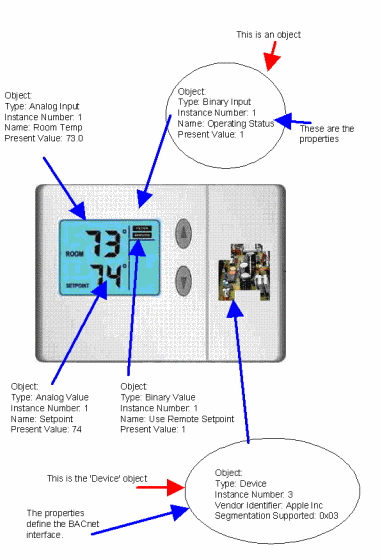
Each object is uniquely identified within a device by its object type and instance number. Together, these two values form the object identifier used in BACnet services.
Common BACnet Object Types
BACnet defines many standardized object types. Some of the most commonly encountered object types in building automation systems include:
- Analog Input (AI) – Represents a continuously varying measured value, such as temperature.
- Analog Output (AO) – Represents a continuously varying command value written to a device.
- Binary Input (BI) – Represents a two-state measured condition, such as on/off or normal/fault.
- Binary Output (BO) – Represents a two-state command value.
The object type defines what properties are required, optional, or not applicable for that object. BACnet clients use this standardized structure to interpret object data correctly.
Commonly Used BACnet Properties
Each BACnet object exposes a set of properties that describe its identity, current state, and behavior. While the full list of properties depends on the object type, several properties are commonly used across many object types.
Object Identifier: Combines the object type and instance number. The instance number must be unique among objects of the same type within a device.
Object Name: A human-readable name used to identify the object. This property is often used as a tag or label within engineering tools.
Description: An optional text field typically used to provide additional context about the object’s purpose or physical meaning.
Present Value: Represents the current value of the object. For inputs, this is the measured value; for outputs or values, it is the commanded value.
Reliability: Indicates whether the present value is valid or if the object is reporting a fault or abnormal condition.
Viewing Objects and Properties with CAS BACnet Explorer
CAS BACnet Explorer provides a practical way to browse BACnet objects and inspect their properties in real time. Once a device is discovered, the tool presents a hierarchical view of all objects supported by the device, grouped by object type.
Engineers can select any object to view its properties, read current values, and—where permitted—write to writable properties such as Present Value. This makes it easier to understand how a device exposes its internal data and to verify correct behavior during commissioning or troubleshooting.
Because BACnet objects and properties follow standardized definitions, tools like CAS BACnet Explorer can interact consistently with devices from different manufacturers.
BACnet Objects and Properties FAQ
What is a BACnet object?
A BACnet object is a standardized data structure used to represent a specific function, measurement,
or control point within a BACnet device. Each object belongs to a defined object type and contains a
set of properties.
What is the Device object in BACnet?
The Device object represents the BACnet device itself. It provides identification and capability
information and is required in every BACnet device.
What is a BACnet property?
A BACnet property is an attribute of a BACnet object. Properties describe the object’s identity,
configuration, current value, and status.
What is the Present Value property?
Present Value is the property that holds the current value of an object. For input objects, it
reflects measured data. For output or value objects, it reflects the commanded value.
How does BACnet indicate invalid or faulty data?
BACnet uses the Reliability property to indicate whether an object’s Present Value is valid or if
a fault or abnormal condition exists.
Can all BACnet properties be written?
No. Only properties defined as writable in the BACnet standard and permitted by the device
implementation can be written. Many properties are read-only.