Control Systems Vulnerabilities

Modern control systems (industrial automation, building automation, and IoT-connected infrastructure) increasingly rely on Ethernet/IP networks, embedded web interfaces, remote access pathways, and software-driven configuration tools. These capabilities improve visibility and integration, but they also expand the attack surface. “Control system vulnerabilities” typically include weaknesses in device firmware, insecure default configurations, exposed services, poor network segmentation, inadequate patching, and weak authentication/authorization controls.
The resources below are a curated set of external articles and case studies that illustrate common failure modes and practical consequences. Use them to understand how vulnerabilities are discovered, how attackers chain misconfigurations into incidents, and what defensive patterns reduce risk in real deployments (e.g., segmented networks, least-privilege access, secure remote access, and a disciplined vulnerability management program).
Common Vulnerability Themes in Control Systems
While each environment is different, control systems often share several recurring security issues: (1) exposed management interfaces (HTTP/HTTPS, Telnet/SSH, proprietary ports) reachable from untrusted networks, (2) shared credentials or weak password policies, (3) unpatched firmware/software due to operational constraints, (4) flat networks where control devices and enterprise IT share the same broadcast domain, and (5) insufficient monitoring for abnormal traffic patterns and device behavior.
Building systems are not immune. Lighting control networks, HVAC controllers, and gateways that bridge protocols (for example, between BACnet and IP networks) should be treated as operational technology (OT) assets. If a site has both legacy platforms (e.g., TLC-era components) and current platforms (e.g., LightSweep-based systems), the security posture should be assessed consistently across generations: confirm what is reachable, who can configure it, how changes are audited, and how remote access is controlled.
Resource Summaries
Each item below includes a brief technical summary to help you understand what the resource is about before you open it. These summaries do not replace the original documents; they are intended to improve search/AI discoverability and provide context for engineers and system integrators reviewing risk in control and IoT deployments.
Examining the Vulnerabilities of Industrial Automation Control Systems (IACS)
This document focuses on how industrial control environments differ from typical IT systems, why patching and change control are
operationally complex, and what architectural controls (segmentation, zoning, and controlled conduits) are commonly used to reduce
exposure. It is useful for readers who need a structured vocabulary for discussing IACS security and for mapping controls to OT
constraints.
Read the full article here: Examining_the_Vulnerabilities_of_Industrial_Automation_Control_System_(IACS).pdf
Vulnerability Management at Diebold (Automation)
This case study emphasizes operational vulnerability management: identifying assets, tracking versions, prioritizing remediation,
validating fixes, and coordinating changes across stakeholders. For control systems, a key takeaway is that vulnerability management
is a lifecycle activity (inventory → assessment → mitigation → verification), not a one-time audit.
Read the full article here: https://www.rapid7.com/docs/cs-diebold.pdf
Security Vulnerabilities of Internet of Things: A Case Study of a Smart Plug System
This paper is relevant for anyone deploying “smart” edge devices that include mobile apps, cloud services, and local wireless links.
It illustrates how weaknesses can exist across the full stack (device firmware, local network communications, cloud APIs, and user
account handling). Even when the device is simple (on/off control), the supporting ecosystem can introduce meaningful risk.
Read the full article here: http://ieeexplore.ieee.org/document/7932855/
Hacking IoT: A Case Study on Baby Monitor Exposures and Vulnerabilities
This report demonstrates how consumer IoT devices can become remotely accessible due to insecure defaults, exposed services, or weak
authentication practices. The engineering lesson transfers to control systems: if a device has a network service, remote access path,
or cloud relay, it needs explicit hardening steps (credential management, restricted inbound access, and routine review of exposure).
Read the full article here: https://www.rapid7.com/docs/Hacking-IoT-A-Case-Study-on-Baby-Monitor-Exposures-and-Vulnerabilities.pdf
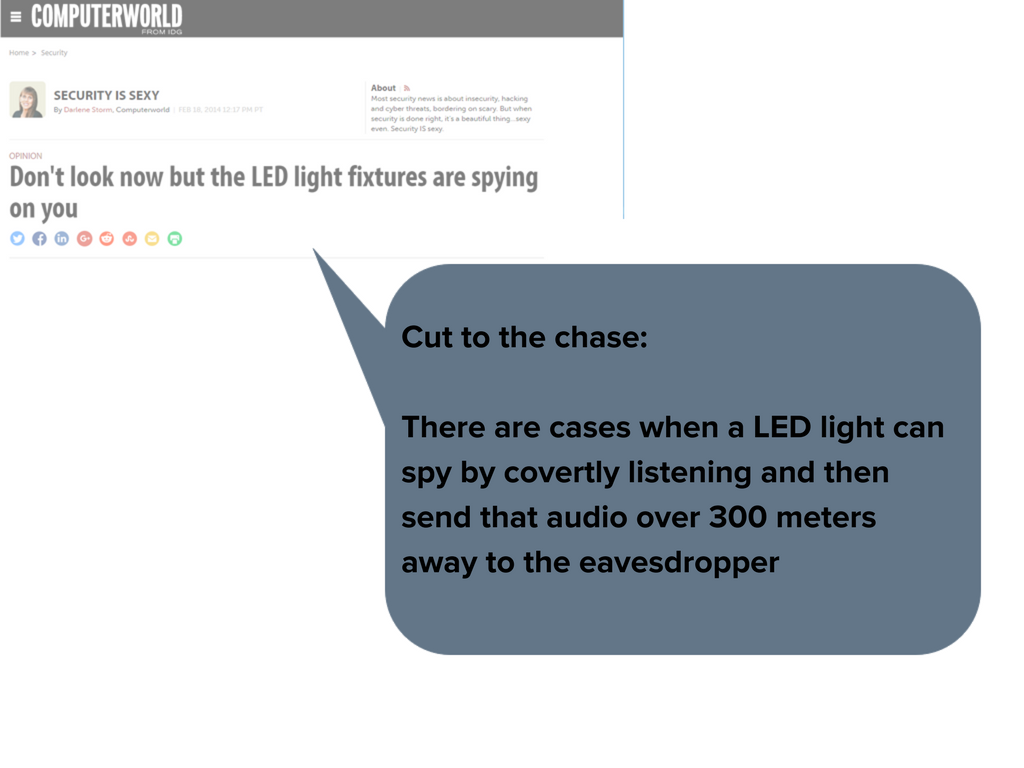
LED Light Fixtures and Unexpected Data Collection
This article highlights that network-connected devices can unintentionally collect, transmit, or expose data. In building contexts,
this can include occupancy-related telemetry, device identifiers, network metadata, or operational status information. The practical
security angle is to treat connected lighting and building devices as managed assets: limit what networks they can reach, review what
services are enabled, and validate that integrations do not expose management planes to general-purpose networks.
Read the full article here: https://www.computerworld.com/article/2475911/security0/don-t-look-now-but-the-led-light-fixtures-are-spying-on-you.html
Examples of IoT Hacking and Vulnerabilities
This overview aggregates several incident patterns to show how compromises occur in practice: exposed endpoints, weak credentials,
unpatched software, and insecure remote access. While the examples may span different device categories, the recurring engineering
takeaway is consistent: reduce exposure, remove unnecessary services, and implement defense-in-depth rather than relying on a single
control.
Read the full article here: https://www.iotforall.com/5-worst-iot-hacking-vulnerabilities/
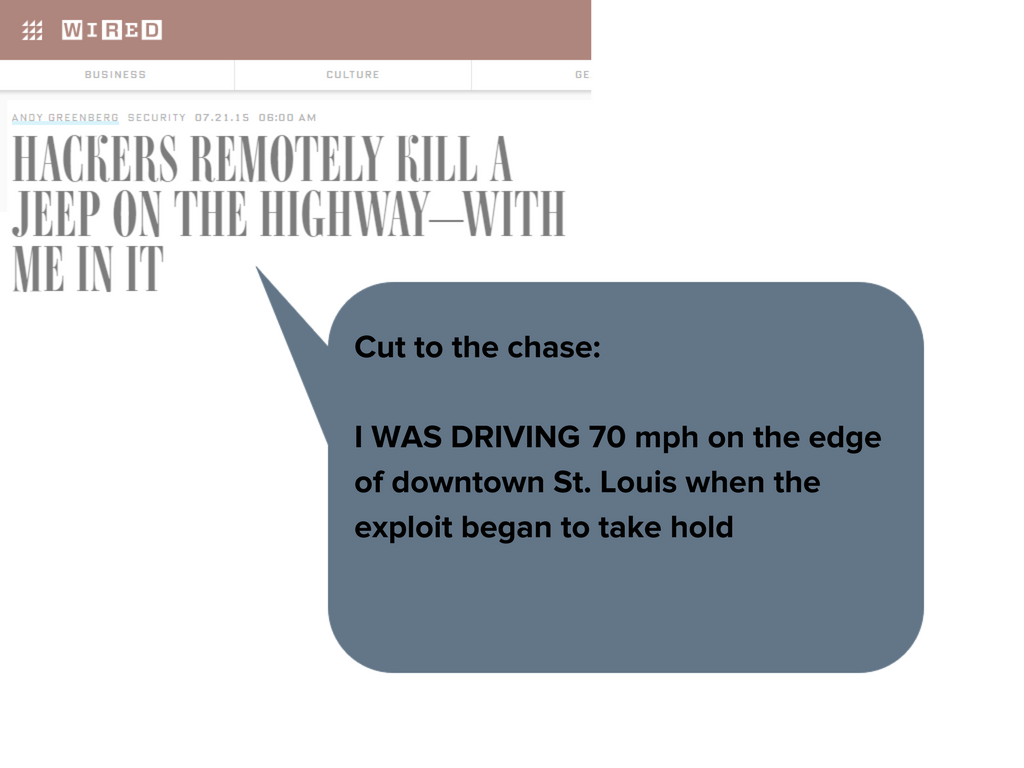
Remote Exploitation Demonstration (Vehicle Systems)
Although this example is automotive, it is a clear illustration of a broader control-system principle: when a network-connected
subsystem is reachable and insufficiently isolated, attackers may pivot from one interface to functions that affect safety or
availability. In OT and building systems, analogous risks can include unplanned shutdowns, loss of supervisory visibility, unsafe
control outputs, or forced configuration changes.
Read the full article here: https://www.wired.com/2015/07/hackers-remotely-kill-jeep-highway/
FAQ
What is a “control system vulnerability”?
A control system vulnerability is a weakness that can be exploited to impact confidentiality (data exposure), integrity (unauthorized
changes), or availability (service disruption) of devices and software used to monitor or control physical processes.
Why are OT/control environments often harder to patch than IT systems?
Control systems may have strict uptime requirements, limited maintenance windows, vendor qualification constraints, and safety or
process dependencies that require extensive testing before updates are applied.
What is a practical first step for reducing risk?
Establish an accurate asset inventory and network map (what exists, where it is, and what it talks to). This enables prioritization
of exposure reduction (segmentation, restricted remote access) and provides a baseline for vulnerability tracking.