Elon Musk, The Game Changer
The question of whether Tesla battery cells are superior to conventional 18650 formats is central to the efficiency of modern electric vehicles (EVs). Tesla has consistently optimized its battery architecture through collaborative research with Panasonic, moving from industry-standard sizes to custom form factors.
While the 18650 cell was the "workhorse" of early Tesla models like the original Model S and Model X, the shift to the 2170 cell represented a 50% increase in volume and nearly double the effective current capacity. This guide explores the technical specs, cost drivers, and the future of Tesla's "tab-less" 4680 technology.
Tesla 2170 vs. Conventional 18650: Technical Comparison
The primary difference lies in the physical dimensions and energy density. The "2170" name refers to its 21mm diameter and 70mm height, compared to the 18mm x 65mm profile of the 18650.
| Feature | 18650 Cell | 2170 Cell |
|---|---|---|
| Dimensions | 18mm x 65mm | 21mm x 70mm |
| Max Current | ~3,000 mA | ~6,000 mA |
| Energy Density | Standard | ~20% Higher |
| Primary Use | Model S, Model X (Early) | Model 3, Model Y |
According to industry benchmarks and disclosures from Elon Musk, the 2170 cell achieved the highest energy density at its launch while simultaneously being the most cost-effective to mass-produce.
Reducing Costs: The Material Drivers
Tesla successfully reduced battery costs by approximately 35% by optimizing the supply chain for key materials. The overall cost of a lithium-ion battery pack is primarily driven by four components:
- Nickel: Used for high energy density in NCA (Nickel Cobalt Aluminum) cathodes.
- Cobalt: Provides stability but is expensive and ethically complex to source.
- Lithium & Graphite: Essential for ionic conductivity and anode stability.
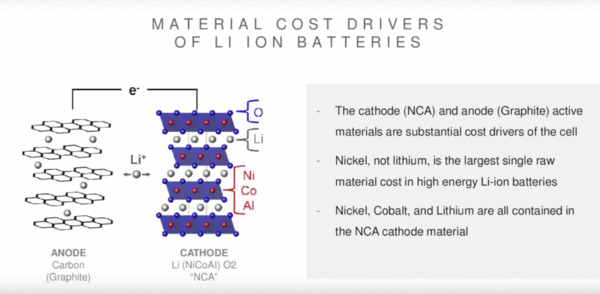
Fig: Material cost drivers of Tesla's lithium-ion batteries
To further lower costs and improve ethics, Tesla has pivoted toward LFP (Lithium Iron Phosphate) chemistries for standard range vehicles, which eliminates cobalt entirely while offering longer cycle lives.
The Next Step: Tab-less 4680 Cells
As of 2026, the 4680 cell (46mm x 80mm) represents the next frontier. By using a "tabless" design, Tesla has shortened the electrical path for electrons, reducing heat generation and allowing for 6X the power and 5X the energy storage per cell compared to the 2170.
These cells are designed to be structural, meaning the battery pack itself forms part of the car's frame, reducing the vehicle's weight and increasing overall range.