Embedding a BTL-Certified BACnet/IP Stack in a Medical Device
 Case Study – Embedding a BTL-Certified BACnet/IP Stack in a Medical Device
Please CONTACT US for questions
Case Study – Embedding a BTL-Certified BACnet/IP Stack in a Medical Device
Please CONTACT US for questions
Overview
A manufacturer develops hospital-grade clean air devices intended for use in medical environment. The device required an embedded BACnet/IP interface so it could be integrated into building management systems during installation.
Because the product was designed for hospital deployments, the BACnet implementation also needed to achieve BTL certification, A requirement for acceptance in many hospital environments as well as commercial and institutional installations.

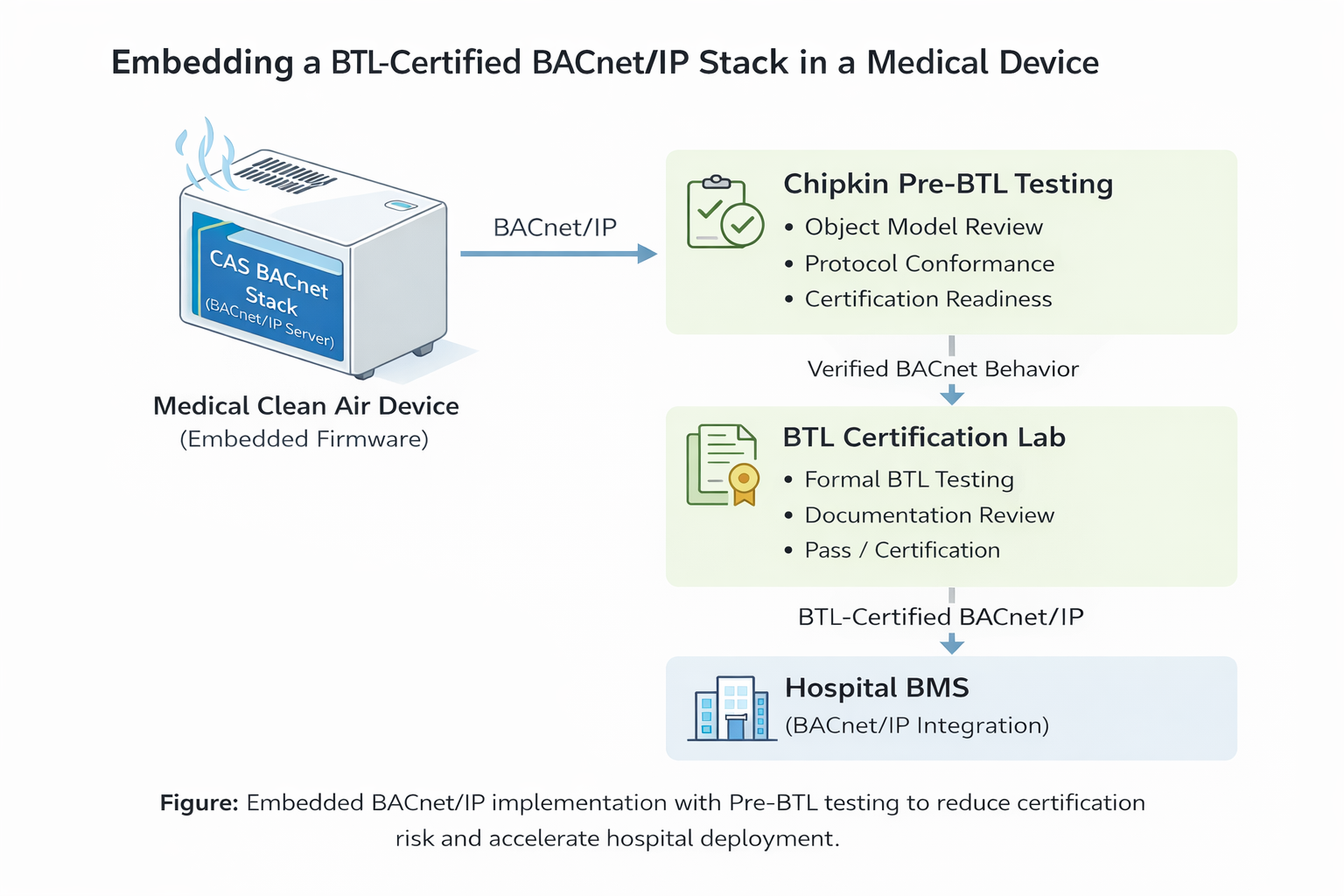
The manufacturer licensed Chipkin’s BACnet Stack (CAS BACnet Stack) and engaged Chipkin for Pre-BTL testing services. Chipkin supported the BACnet stack implementation, reviewed BACnet behavior against certification requirements, and prepared the device for formal BTL testing. This included executing BTL test plans, identifying conformance issues, and providing detailed guidance on required changes.
Chipkin also supported UV Partners during the official BTL testing phase by assisting with documentation review, test clarification, and issue resolution. This approach reduced iteration during certification and shortened the overall path to BTL approval.
Customer Goals and Challenges
The customer’s goal was not simply to add BACnet, but to implement a BACnet interface that would integrate cleanly with BACnet BMS, reduce installation and commissioning effort, and achieve BTL certification. Certification was required to support deployment across a wide range of regulated environments, including hospitals, government buildings, and military facilities.
Meeting these goals introduced challenges beyond basic protocol implementation. BACnet requires domain-specific design decisions, not just message encoding. Building automation systems expect consistent object models, standard services, and predictable runtime behavior. Many BACnet issues are subtle and do not become apparent until interoperability testing or formal certification begins.
- Successfully navigating these challenges requires deep experience in the BACnet industry, including:
- Understanding what constitutes a well-designed BACnet interface in real deployments
- Knowing how different BMS platforms interpret and rely on BACnet behavior
- Identifying common implementation pitfalls early, before they become costly to correct
- Anticipating how BTL test tools and real-world systems will exercise the device
Without this expertise, manufacturers often reach BTL testing with a “mostly working” implementation that still fails certification due to subtle but critical compliance issues.
Chipkin’s approach to the solution
Our client licensed Chipkin’s CAS BACnet Stack and engaged Chipkin to support the project from initial BACnet integration through BTL certification. The BACnet stack was embedded directly into the device firmware, providing a standards-compliant BACnet/IP interface suitable for regulated environments.
Chipkin provided end-to-end BACnet expertise throughout the project, including:
- Rapid integration of a proven BACnet stack into the embedded device
- Early review of BACnet object models and service behavior
- Certification-focused testing to identify issues prior to BTL submission
- Clear explanations of issues discovered and guidance on how to resolve them correctly
- Ongoing support during the official BTL lab testing phase
By addressing BACnet design and conformance issues early, the solution reduced rework during certification and provided a clear, controlled path from embedded implementation to BTL approval.
Results and Key Takeaway
The project resulted in a clean, standards-compliant BACnet/IP interface suitable for hospital and other regulated environments.
Key outcomes included:
- Reduced installation and commissioning effort for BACnet integrators
- Fewer issues encountered during formal BTL lab testing
- A faster and more predictable path to BTL certification
- Increased confidence that the device will interoperate reliably across a wide range of BMS platforms
- Successful completion of BTL testing, enabling deployment in hospitals and other facilities where certification is mandatory
For hospital-grade products, BACnet integration is not simply a software task—it requires industry expertise. By working with Chipkin from initial BACnet integration through BTL certification, the customer reduced risk, lowered support costs, and ensured the product was ready for real-world BACnet deployments.
FAQ
What does it mean to embed a BACnet/IP stack into a device? +
Embedding a BACnet/IP stack means implementing BACnet communication directly within the device firmware rather than relying on an external gateway or protocol converter. This allows the device to present itself as a native BACnet device on the network, supporting standard BACnet objects, services, and behaviors expected by building management systems.
Why is BTL certification important for hospital and regulated environments? +
Many hospitals, government buildings, and institutional facilities require BTL certification to ensure that BACnet devices conform to the standard and interoperate reliably with building automation systems. BTL certification reduces integration risk, simplifies acceptance testing, and is often a prerequisite for deployment in regulated environments.
What is Pre-BTL testing and how does it reduce certification risk? +
Pre-BTL testing involves running BTL-style test plans and reviews before submitting a device to the official BTL lab. This helps identify BACnet conformance issues early, when they are faster and less costly to correct. Pre-BTL testing typically reduces the number of failures, retests, and delays encountered during formal certification.
Does Chipkin modify customer firmware during Pre-BTL testing? +
No. Chipkin does not modify customer source code. During Pre-BTL testing, Chipkin identifies conformance issues, explains the root cause, and provides guidance on how to resolve them. All firmware changes are implemented by the customer’s engineering team.
Can the CAS BACnet Stack be used in other embedded or industrial products? +
Yes. The CAS BACnet Stack is designed for embedded and OEM applications across building automation, industrial, and infrastructure products. It supports BACnet/IP and can be adapted to a wide range of hardware platforms and operating environments.