EtherNet/IP Protocol Overview and Industrial Communication Basics
Ethernet Industrial Protocol (IP)
Ethernet/IP (often written as EtherNet/IP or EIP) is an industrial networking technology that carries the Common Industrial Protocol (CIP) over standard Ethernet and IP. Unlike fieldbuses that define physical layer and media access rules, EtherNet/IP primarily standardizes the application layer behavior (CIP objects, services, and messaging models) and uses conventional Ethernet and TCP/UDP/IP as the transport. This is one reason EtherNet/IP is widely used in industrial control systems: it leverages commodity Ethernet infrastructure while maintaining a device model and service set designed for automation use cases.
In practice, EtherNet/IP devices are typically PLCs, remote I/O, drives, safety controllers, barcode readers, and other industrial endpoints that expose data and configuration through CIP. Engineering and troubleshooting work is usually focused on how the device implements CIP objects, how data is structured into assemblies/tags, and how cyclic I/O performance is maintained on the network.
Messaging Models: Implicit vs Explicit
EtherNet/IP supports two primary CIP communication styles: implicit messaging and explicit messaging. Understanding the difference is fundamental when integrating EtherNet/IP into SCADA, BMS, or protocol gateways, because the port usage, timing behavior, and data structures differ.
Implicit messaging is the cyclic, time-sensitive I/O model used for process data exchanged on a repetitive schedule. It typically carries “produced/consumed” I/O assemblies (sometimes referred to as basic I/O data) that must be delivered with predictable latency. These exchanges are frequently implemented using UDP because the application handles timing and sequence expectations.
Explicit messaging is the request/response model used for configuration, diagnostics, reading or writing parameters, and more complex interactions such as uploading or downloading certain device settings (depending on device capabilities). Explicit messaging is typically implemented over TCP to take advantage of reliable, ordered delivery for transactional operations.
In many systems, both types coexist: implicit messaging carries the real-time operational values, while explicit messaging is used for commissioning, monitoring deeper diagnostic objects, or retrieving information that is not included in cyclic assemblies.
Common Ports and Traffic Characteristics
EtherNet/IP uses standard IP networking plus well-known port conventions for CIP traffic. The following summary reflects typical deployments:
- UDP 2222 is commonly used for implicit messaging (cyclic I/O). This is where produced/consumed I/O data is transmitted at a configured RPI (Requested Packet Interval).
- TCP 44818 is commonly used for explicit messaging (request/response). This is used for reading/writing attributes, diagnostics, parameter access, and other configuration services.
Because implicit messaging is often UDP-based and cyclic, typical troubleshooting focuses on packet loss, jitter, multicast behavior, and switch configuration (IGMP snooping, VLAN segmentation, QoS, and physical topology). Explicit messaging troubleshooting tends to be more transactional and object/service oriented: validating CIP path encoding, class/instance/attribute access, and device-specific object support.
Some implementations support multicast for produced I/O to multiple consumers. This can be efficient, but it also requires careful network design so that multicast does not flood unrelated segments. Where multicast is used, managed switches and proper IGMP handling become important for predictable performance.
Protocol Stack Context
EtherNet/IP is often described as “CIP over Ethernet.” The lower layers are conventional: Ethernet (Layer 2) and IP (Layer 3), with TCP or UDP (Layer 4) carrying CIP payloads at the application layer. This architecture makes EtherNet/IP relatively easy to transport across standard infrastructure, but it does not remove the need for industrial network discipline. Deterministic behavior is achieved through proper design (segmentation, switch selection, loop avoidance, and traffic planning), not through special physical layer guarantees.
From an integration standpoint, engineers usually map EtherNet/IP data to supervisory systems using one of these approaches:
- Gateway/protocol conversion to BACnet, Modbus, or another building/SCADA protocol
- Direct driver in a SCADA platform that speaks EtherNet/IP/CIP explicitly
- Controller-to-controller produced/consumed tags or I/O assemblies within an OT network
The correct approach depends on the data volume, timing requirements, whether the supervisory system expects polling versus subscription behavior, and what the EtherNet/IP device exposes (assemblies, tags, or object sets).
Reference Diagram
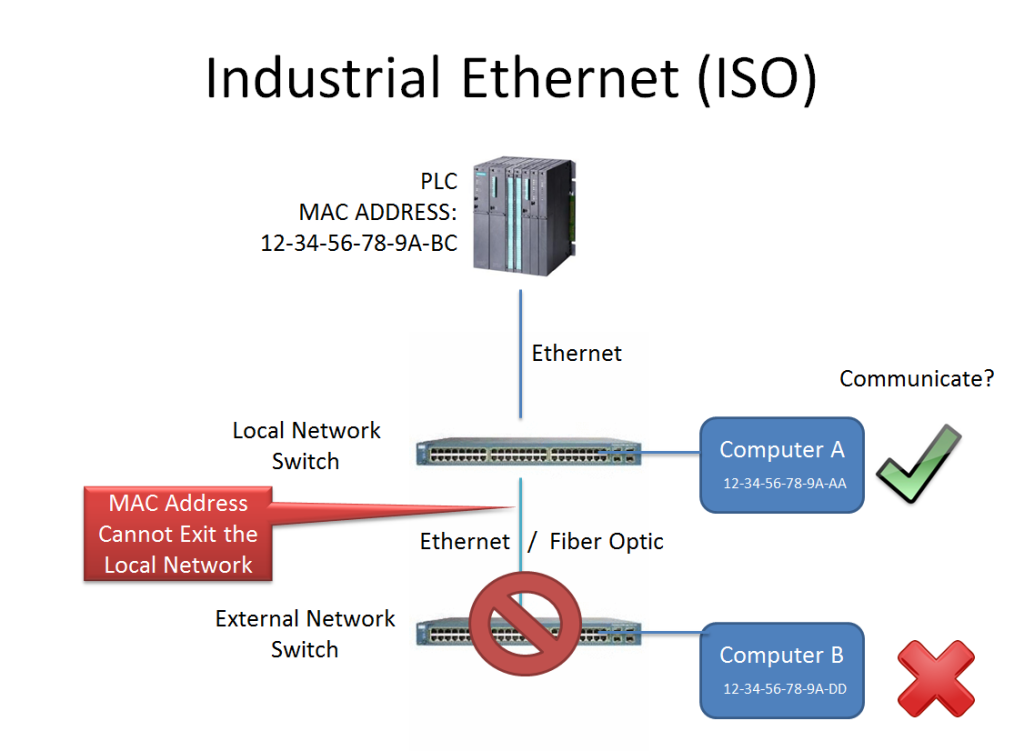
The diagram below provides a visual overview of EtherNet/IP concepts and typical data flow.
EtherNet/IP Gateway Option (Chipkin / QuickServer)
For projects that require integrating EtherNet/IP devices into BACnet or Modbus systems, Chipkin provides an EtherNet/IP gateway option. This is commonly used when a building automation system (BAS/BMS) or SCADA platform needs access to PLC data without deploying an EtherNet/IP driver stack inside the supervisory layer.
Reference link: Ethernet IP to Modbus and BACnet QuickServer Gateway
Typical integration steps include confirming which CIP data elements are required (assemblies or tags), agreeing on scaling/engineering units, selecting update rates appropriate to the application, and validating communication behavior under expected network load. In many retrofit environments, the gateway approach reduces commissioning time because it presents the supervisory system with familiar BACnet or Modbus objects while the gateway handles the CIP-specific details.
Frequently Asked Questions (FAQ)
Is EtherNet/IP the same as standard Ethernet?
No. EtherNet/IP uses standard Ethernet and IP transport, but it defines CIP application behavior on top of it. Two devices can be on Ethernet and still be incompatible unless they implement the same industrial protocol and object models.
Why does EtherNet/IP use UDP for implicit messaging?
Implicit I/O is cyclic and time-sensitive; the application is designed to tolerate occasional loss while prioritizing timely updates. UDP avoids some overhead and supports multicast models used in produced/consumed data exchange.
What is the purpose of TCP 44818 in EtherNet/IP networks?
TCP 44818 is commonly used for explicit CIP messaging: request/response operations such as reading or writing attributes, accessing diagnostics, and device configuration functions.
What is CIP in the context of EtherNet/IP?
CIP is the Common Industrial Protocol. It defines objects, services, and data models used across multiple industrial networks (including EtherNet/IP). EtherNet/IP is one transport for CIP.
When should I use a gateway instead of a native EtherNet/IP driver?
Gateways are typically used when the supervisory system is built around BACnet or Modbus, when you want to keep EtherNet/IP traffic contained within an OT segment, or when you prefer a protocol conversion approach that normalizes data into the BAS/SCADA protocol already deployed.
What is the most common root cause of unreliable implicit I/O performance?
In many deployments, performance issues are caused by network design problems: unmanaged multicast, lack of IGMP handling, oversubscription, duplex mismatches, or inadequate segmentation between control traffic and general IT traffic.