FieldServer Scaling and Bit Packing Explained
FieldServer gateways frequently act as protocol translators between systems that use different data models, data sizes, byte ordering, and numeric representations. Scaling and bit packing are core FieldServer capabilities that allow raw data read from one protocol (such as Modbus) to be transformed into values that are meaningful, usable, and standards-compliant for another protocol such as BACnet.
This article explains what scaling and bit packing mean in the context of FieldServer configuration files, why they are commonly required in real-world integrations, and how these functions are typically applied when reading or serving Modbus data.
What Is Scaling in a FieldServer?
Scaling is the process of converting a raw numeric value into a different numeric form. In building and industrial automation systems, devices often store values in a format that is optimized for communication efficiency rather than human readability. For example, a temperature value may be transmitted as an integer representing tenths or hundredths of a degree.
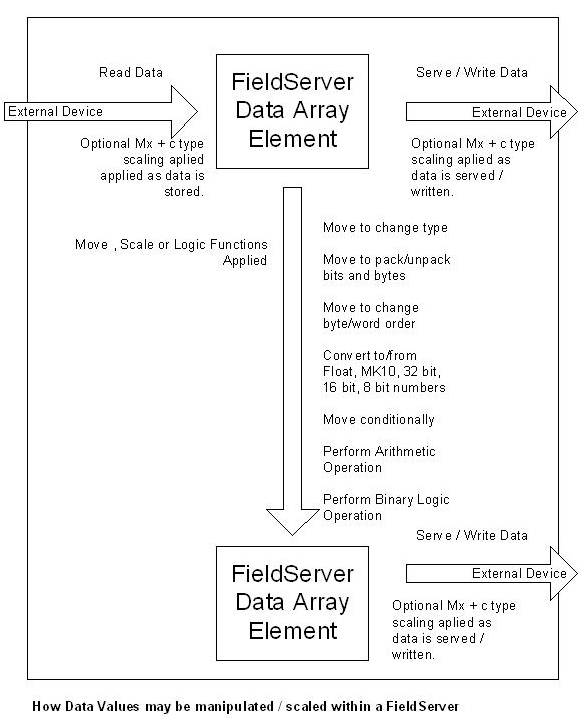
FieldServers allow scaling operations to be applied to each block of data as it is read from or written to a device. This means raw values can be multiplied, divided, offset, or otherwise transformed before being exposed to a client system. As a result, the destination system sees properly scaled engineering values rather than protocol-level representations.
What Is Bit Packing?
Bit packing refers to storing multiple Boolean or status values inside a single data word. This is very common in protocols such as Modbus, where a single 16-bit or 32-bit register may represent many individual states such as alarms, mode flags, or digital inputs.
FieldServers support packed data types that allow each individual bit within an 8-bit, 16-bit, or 32-bit value to be addressed independently. This allows a single Modbus register to be mapped cleanly into multiple discrete BACnet objects or status points.
Common FieldServer Scaling and Conversion Operations
FieldServer configuration files support a wide range of data manipulation functions. These functions can be applied periodically or triggered whenever new data is received from a source device.
- Change data type: Convert between any supported FieldServer data types.
- Pack and unpack bits: Address individual bits within 8-, 16-, or 32-bit values.
- Change byte or word order: Handle endianness differences between devices.
- Numeric format conversion: Convert to and from Float, IEEE-754, MK10, 32-bit, 16-bit, and 8-bit values.
- Conditional moves: Apply transformations only when defined conditions are met.
- Arithmetic operations: Addition, subtraction, multiplication, division, square, and square root.
- Binary logic operations: AND, OR, NOT, greater than, less than, and comparison logic.
When Are These Functions Applied?
Most scaling and bit manipulation functions in a FieldServer can be configured to run either on a fixed time interval or immediately when the source data changes. This flexibility allows integrators to balance system responsiveness against network and CPU usage.
In many integrations, scaling is applied at read time so that downstream systems never see raw values. In other cases, bit unpacking is used to expose detailed device status without requiring additional Modbus registers or custom firmware changes.
Why Scaling and Bit Packing Matter in Real Projects
In real-world automation projects, mismatched data formats are one of the most common integration challenges. Without proper scaling and bit unpacking, operators may see incorrect values, lose visibility into device status, or require extensive custom logic in the destination system.
By performing these transformations directly in the FieldServer, integrators can create cleaner, more maintainable systems. The gateway becomes the single point where protocol- specific quirks are handled, allowing higher-level systems to remain vendor-neutral and easier to support long term.
FAQ: FieldServer Scaling and Bit Packing
Do scaling operations affect performance?
Scaling and bit manipulation are lightweight operations and are designed to run efficiently
on FieldServer hardware. In typical applications, the performance impact is negligible.
Can multiple operations be chained together?
Yes. FieldServer configuration allows multiple transformations to be applied in sequence,
such as unpacking bits, converting data types, and then applying arithmetic scaling.
Is scaling required for every integration?
Not always, but it is very common. Any time devices use raw integers, packed status words,
or non-standard numeric formats, scaling and bit packing are usually required.