New Battery Research Targets Extended Electric Vehicle Range
Advances in battery technology continue to play a critical role in extending the driving range of electric vehicles. Research teams are exploring new cell architectures and materials with the goal of increasing energy density while maintaining safety, manufacturability, and compatibility with existing vehicle platforms.
One such research effort is being led by Mareike Wolter, Project Manager of Mobile Energy Storage Systems at the Fraunhofer-Gesellschaft in Dresden, Germany. The team is investigating a novel battery design that could theoretically enable electric vehicles to achieve driving ranges of up to approximately 1,000 kilometers (about 620 miles) on a single charge, under ideal conditions.
Concept Overview
The proposed battery concept is based on a stacked, bipolar electrode architecture. Instead of assembling individual cells connected through external wiring, multiple electrodes are layered directly on top of one another. This configuration reduces inactive materials and internal resistance while increasing volumetric energy density.
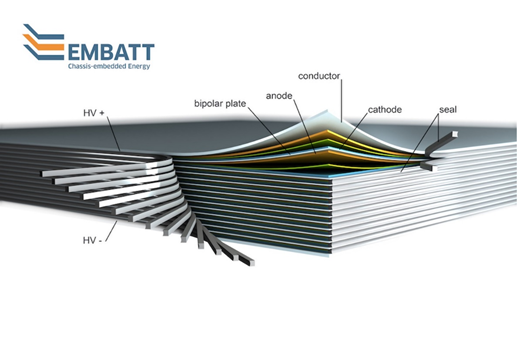
In this design, electrodes are arranged similarly to sheets of paper in a ream. Thin electrolyte layers separate each electrode, while insulating materials prevent unintended electrical short circuits across the stack. Electrical contacts at the top and bottom of the assembly connect the entire stack to the vehicle’s power system.
Physical Packaging and Integration
According to published descriptions, the stacked battery assembly would be sealed within a package occupying approximately one square meter (around 10 square feet). This footprint is intended to be comparable to the battery pack volumes currently used in commercial electric vehicles.
The stated objective is to deliver significantly higher energy capacity without increasing the physical size of the battery system. By fitting within existing space constraints, the design could potentially be integrated into vehicle platforms originally engineered for conventional lithium-ion battery packs.
Achieving this goal would require careful management of thermal behavior, mechanical stability, and long-term degradation, particularly in large-format battery systems subjected to repeated charge and discharge cycles.
Engineering Considerations and Limitations
While projected driving ranges are often calculated under controlled laboratory conditions, real-world performance depends on numerous factors. These include vehicle efficiency, operating temperature, driving style, charging strategy, and system-level losses.
Bipolar battery designs also introduce engineering challenges. These include ensuring uniform current distribution across large electrode areas, maintaining consistent electrolyte performance, and implementing robust safety mechanisms to manage faults within the stack.
As with many early-stage battery concepts, further validation is required to assess scalability, manufacturing cost, reliability, and compliance with automotive safety standards.
Source and Further Reading
The information summarized here is based on publicly available reporting and research descriptions. A detailed overview of the concept can be found at the following source:
https://www.livescience.com/59052-new-battery-could-supersize-electric-cars-range.html
As research progresses, further peer-reviewed data will be required to determine how such battery architectures perform under real-world automotive conditions.


