Simplex 4100 Networked Panel Addressing with a FieldServer
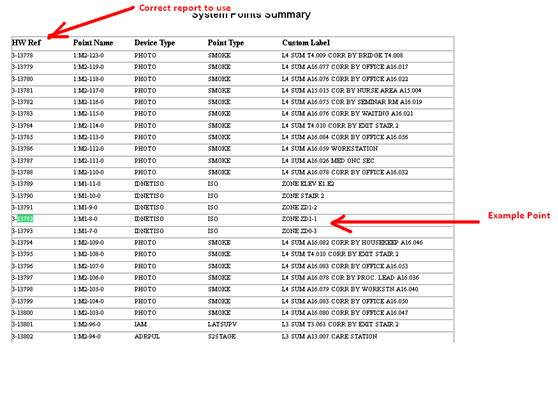
This article describes how to address and monitor points from a Simplex 4100 fire alarm control panel (FACP) when the panel is part of a Simplex 4100 network and integrated through a FieldServer gateway. The focus is on understanding how networked points are collected, stored, and addressed for both passive monitoring and serving data onward to other systems.
The same addressing principles apply whether points originate from a local FACP or a networked FACP. The primary difference lies in how the points are grouped and indexed within the FieldServer data arrays.
Passive Monitoring of Networked Points
To monitor a networked Simplex 4100 point passively, a Map Descriptor is configured to collect event data from the panel. In this configuration, the Map Descriptor length is intentionally set to a large value so that all networked points can be captured without requiring individual definitions for each point.
Aside from the expanded length, there is no functional difference between receiving events from a local FACP and receiving events from a networked FACP. The FieldServer processes both in the same manner.
Example Map Descriptor definition:
                Map_Descriptor_Name ,Data_Array_Name ,Data_Array_Offset ,Function ,Node_Name ,
                sim4100_func ,sim4100_card ,sim4100_point ,sim4100_sub ,protocol ,length ,
                da_byte_name ,da_float_name
                Card_03_Points ,DA_CARD3 ,0 ,passive ,Simplex_01 ,xpoint ,3 ,0 ,256 ,sim4100 ,
                10000 ,DA_P ,DA_F
In this example, all networked points associated with card 3 are collected into the data array DA_CARD3.
Serving Networked Points
To serve a networked Simplex 4100 point to another protocol or system, the correct offset into the data array must be determined. Each point’s state is stored at a specific location within the data array that was populated by the passive Map Descriptor.
In this example, data is stored in the array DA_CARD3. The point Zone ZD1-1 is located at offset 13792 within this array.
The value stored at that offset is an unsigned integer (UINT) with 16 bits. Each bit represents the state of a specific event condition associated with that point.
Reading a Networked Point (C-P-S Addressing)
To read an individual Simplex 4100 point, the Card–Point–Subpoint (C-P-S) addressing scheme must be derived from the data array offset.
The following values are required:
- Card: The panel card number (given).
- Point: The integer result of dividing the address by 256.
- Subpoint: The remainder of the address divided by 256, multiplied by 256.
Example address: 3-13792
Card = 3
Point = truncate(13792 / 256) = truncate(53.875) = 53
Subpoint = 256 × remainder(13792 / 256) = 256 × 0.875 = 224
The resulting C-P-S address is therefore 3-53-224.
Operational Notes
Understanding how networked Simplex 4100 points are packed into FieldServer data arrays is essential for accurate monitoring and serving of fire alarm events. Using large passive Map Descriptors simplifies configuration while still allowing precise access to individual points through calculated offsets.
This approach is commonly used when integrating Simplex 4100 networks into building management systems, historian platforms, or supervisory interfaces that require reliable and deterministic access to alarm and status information.