Electric Vehicle Battery Tech Forecast and Future Market Trends
Electric vehicle (EV) battery technology is a key factor shaping the growth, performance, and adoption of electric vehicles worldwide. Advances in battery chemistry, energy density, charging speed, and lifecycle characteristics directly influence vehicle range, cost, and usability. As a result, battery technology forecasts are closely tied to expectations for the future electric vehicle market.
This page summarizes publicly available research and commentary on future electric vehicle battery technologies, with a focus on emerging concepts that aim to address current limitations of lithium-ion batteries. The intent is to provide an informational overview of trends and research directions rather than to predict specific commercial outcomes.
Current Battery Technology and Market Context
Today, most electric vehicles rely on lithium-ion battery technology. Lithium-ion batteries offer a balance of energy density, reliability, and manufacturability that has enabled large-scale EV production. However, limitations remain, including charging time, material costs, thermal management complexity, and long-term degradation.
These constraints have driven ongoing research into alternative battery chemistries and materials that could improve performance metrics such as driving range, charge rate, and power delivery. Battery innovation is therefore a central driver of future EV market growth and adoption.
Graphene-Based Battery Research
One area of research frequently discussed in technology forecasts is the use of graphene in battery construction. Graphene is a form of carbon known for its high electrical conductivity, mechanical strength, and surface area. These properties have led researchers to explore its potential role in next-generation energy storage systems.
Graphene-based battery concepts have been associated with significantly higher theoretical energy densities compared to conventional lithium-ion batteries. Some published claims suggest that such batteries could enable electric vehicles with substantially longer driving ranges while also supporting faster charge and discharge rates.
Energy Density, Charging, and Performance Claims
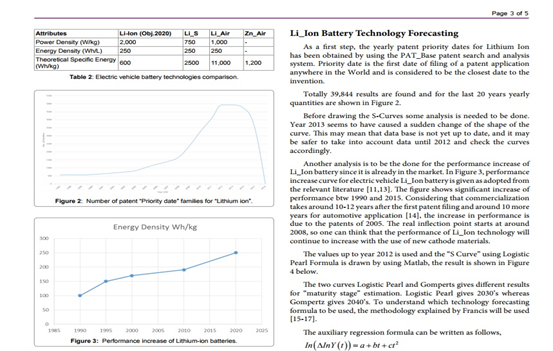
Public discussions around graphene-based batteries often reference significantly higher energy density when compared to current lithium-ion technology. For example, some research materials cite energy densities on the order of hundreds of watt-hours per kilogram, exceeding typical lithium-ion values reported in commercial EV batteries.
Faster charging is another frequently cited advantage. High charge and discharge rates are particularly important for electric vehicles, as they affect both charging convenience and vehicle acceleration performance. These characteristics are central to improving the overall user experience and expanding EV adoption.
Research Publications and Media References
Several academic and industry publications discuss future battery technologies and their potential impact on the electric vehicle market. One example is the following research paper, which explores technology forecasts and market estimation related to electric vehicle battery development:
Technology Forecast for Electric Vehicle Battery Technology and Future Market Estimation (PDF)
Additional commentary and discussion can also be found in publicly available video presentations, such as the following overview:
Interpreting Future Market Trends
While emerging battery technologies show promise in laboratory and early research settings, large-scale commercialization depends on factors such as manufacturing scalability, cost, safety, and long-term reliability. Forecasts and research studies provide insight into potential directions but do not guarantee near-term deployment in production vehicles.
Understanding these trends is valuable for engineers, researchers, and industry planners evaluating how advances in battery technology may influence the future electric vehicle market. Continued research and development will determine how and when these technologies transition from experimental concepts to practical applications.
FAQ
Why is battery technology critical for electric vehicles?
Battery technology affects vehicle range, charging time, cost, and overall performance, making it a key factor in EV adoption.
What are graphene-based batteries?
They are experimental battery concepts that use graphene materials to potentially improve energy density and charge rates.
Are graphene batteries commercially available?
At present, graphene-based batteries are primarily in research or early development stages rather than widespread commercial use.


