ENOTE 0056 – Configuring FieldServer for Hot Standby Mode 1 Configuration
This ENOTE provides a focused, step-by-step guide for configuring a FieldServer system using Hot Standby Mode 1. Hot Standby is commonly used in mission-critical automation and control systems where high availability and redundancy are required.
In Mode 1, a Primary and Secondary FieldServer operate in a defined active/standby relationship. If the Primary unit fails or is powered down, the Secondary automatically assumes control, minimizing downtime and maintaining network continuity.
ENOTE 0056 – Configuring FieldServer for Hot Standby Mode 1
Hot Standby Mode 1 configuration is intentionally simple. Only two configuration files are required:
HSB_P.ini for the Primary FieldServer and HSB_S.ini for the Secondary
FieldServer. No changes to the config.csv file are required.
This approach reduces configuration complexity and helps ensure consistent behavior across both devices. Each FieldServer reads its respective INI file at startup to determine its role in the Hot Standby pair.
Required files:
- HSB_P.ini – Used by the Primary FieldServer
- HSB_S.ini – Used by the Secondary FieldServer
Primary Configuration (HSB_P.ini)
The HSB_P.ini file for the Primary FieldServer only needs to include a minimal set of
parameters related to Hot Standby operation. These settings define the device as the Primary
unit and enable Hot Standby functionality.
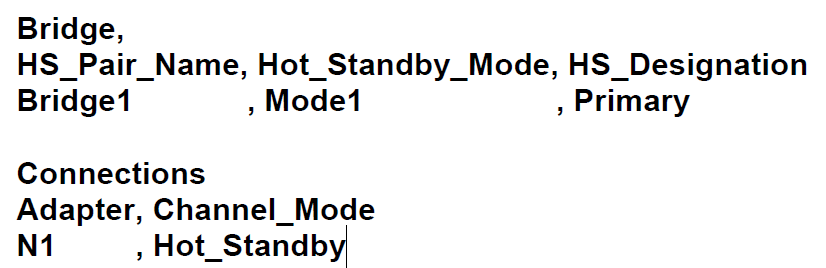
No additional protocol or data mapping changes are required in this file. The Hot Standby mechanism operates independently of the gateway’s protocol configuration.
Secondary Configuration (HSB_S.ini)
The HSB_S.ini file is nearly identical to the Primary configuration, with one key
difference: the HS_Designation field must be set to Secondary.
This designation ensures that the Secondary FieldServer remains in standby mode until a failover event occurs.

Procedure: Setting Up Hot Standby Mode 1
- Download HSB_P.ini to the Primary FieldServer and HSB_S.ini to the Secondary FieldServer. Ensure that both the local and remote file names match exactly.
- Restart both FieldServers to apply the new Hot Standby configuration.
- After startup, confirm that the Primary FieldServer displays a solid Yellow Active LED.
-
Verify operation by checking Ruinet’s error screen for the message:
System → Hot Standby (ETH): This Bridge now ACTIVE. - Test failover by disconnecting power from the Primary FieldServer. The Secondary’s Active LED should turn solid Yellow, indicating it has taken control.
- Restore power to the Primary FieldServer to return control to the Primary unit.
Best Practices and Recommendations
- Always test failover behavior in a controlled environment before deploying to production.
- Ensure both FieldServers are running compatible firmware versions.
- Use reliable power sources and network cabling for both units.
- Clearly label Primary and Secondary devices to avoid maintenance errors.
- Monitor system logs periodically to confirm Hot Standby status.
FAQ – Hot Standby Mode 1
1) What is Hot Standby Mode 1?
Hot Standby Mode 1 is a redundancy configuration where a Primary FieldServer is active and a Secondary FieldServer remains on standby, automatically taking over if the Primary fails.
2) Do I need to modify config.csv?
No. Hot Standby Mode 1 only requires changes to the HSB_P.ini and HSB_S.ini files.
3) How do I know which unit is active?
The active FieldServer will display a solid Yellow Active LED and will report its status in Ruinet’s diagnostic messages.
4) Can the system automatically recover after the Primary comes back online?
Yes. When power is restored to the Primary FieldServer, control can be returned to the Primary depending on system configuration and restart behavior.
5) Is Mode 1 suitable for all applications?
Mode 1 is ideal for straightforward redundancy scenarios. More complex failover requirements may benefit from Hot Standby Mode 2 or other redundancy architectures.