GERMAN UTILITY ANNOUNCES PLANS FOR WORLD’S BIGGEST BATTERY
The transition to renewable energy requires massive storage solutions to handle fluctuating supply. In a landmark development, the German utility EWE Gasspeicher announced plans for the world’s largest battery system, housed within massive underground salt caverns.
This project, known as brine4power (b4p), utilizes innovative redox flow technology to store electricity directly in liquid electrolytes. By leveraging existing geological formations typically used for natural gas, EWE aims to provide grid-scale stability with an environmentally friendly storage medium.
Redox Flow Technology in Salt Caverns
Unlike traditional lithium-ion batteries that use solid electroactive materials, the brine4power system is a redox flow battery. It stores energy in two saltwater-based liquid electrolytes separated by a membrane. The key technical advantage of this system is the decoupling of power (determined by the stack size) and energy capacity (determined by the volume of the tanks or caverns).
- Projected Capacity: Up to 700 MWh of storage with an output of roughly 120 MW.
- Scale: Large enough to supply a major city like Berlin with electricity for one hour.
- Cost Efficiency: Estimated construction costs are approximately $1,100 per MW.
- Historical Context: For comparison, Sumitomo Electric Industries™ previously operated a major flow battery in Japan with a capacity of about 60 MWh.
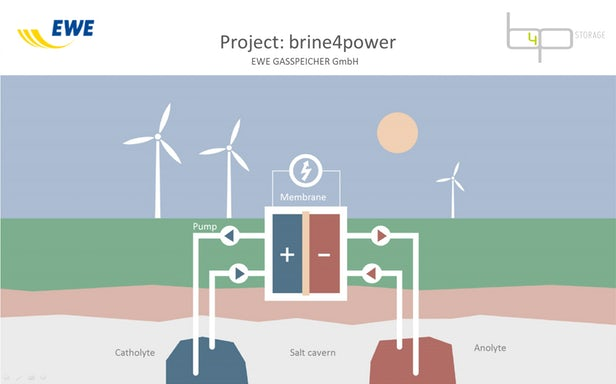
Environmentally Friendly Electrolytes
A standout feature of the brine4power system is its electrolyte chemistry. Developed in collaboration with Friedrich Schiller University in Jena, the system replaces heavy metals and sulfuric acid with saltwater electrolytes and recyclable polymers.
Benefits of the Jena University System:
- Non-Toxic: Eliminates the need for vanadium or lead, which are common in other flow battery designs.
- Recyclable: Uses organic polymer molecules that can be safely processed at the end of their lifecycle.
- Geological Stability: Salt rock is ideal for storage due to its low porosity, impermeability, and ability to "self-heal" from minor damage.
Project Status and Energy Transition
Initial testing for brine4power began with large plastic containers at the Jemgum gas storage facility in East Frisia. Following these successful surface trials, EWE planned to migrate the system into two medium-sized underground caverns, each with a volume of approximately 100,000 m³.
FAQ – Salt Cavern Storage
1) Why use salt caverns instead of tanks?
Salt caverns offer massive, naturally sealed volumes that can hold millions of cubic feet of electrolyte, allowing for GWh-scale storage that would be prohibitively expensive to build with steel tanks.
2) Is EWE exploring other storage technologies?
Yes. EWE is also a leader in hydrogen storage, recently proving the viability of storing 100% pure hydrogen in salt caverns near Berlin as part of the HyCAVmobil project.
3) When will the system be fully operational?
While surface tests and cavern preparation are ongoing, EWE expects grid-connected cavern storage to become a core part of the European energy market in the near future.


