Gravity-Powered LED Lights Lighting Developing Countries
A significant portion of the world’s population still lives without reliable access to electricity. In many of these regions, kerosene lamps are commonly used for basic lighting. While widely available, kerosene lamps present serious health and safety risks, including fire hazards, burns, and prolonged exposure to harmful fumes.
Studies have shown that long-term exposure to kerosene lamp fumes can cause severe respiratory damage. In some cases, the impact on lung health has been compared to heavy cigarette smoking. These risks affect not only adults who tend the lamps but also children who are often nearby in confined living spaces.
The Challenge of Affordable, Safe Lighting
Replacing kerosene lamps with safer alternatives is a major challenge in developing regions. Any viable solution must be affordable, durable, and simple to use, while also functioning without reliance on complex infrastructure. Cost is a critical factor, as lighting solutions must be accessible to households with very limited financial resources.
Nonprofit organizations working in this space have focused on technologies that can provide clean, low-cost lighting without ongoing fuel expenses. These efforts aim to reduce health risks, improve safety, and support daily activities such as studying, cooking, and working after dark.
The GravityLight Concept
In response to these challenges, the nonprofit organization SolarAid collaborated with London-based product designers Jim Reeves and Martin Riddiford to explore alternative lighting concepts. The goal was to design a light source that could operate without electricity, batteries, or fuel, while remaining affordable for widespread use in developing countries.
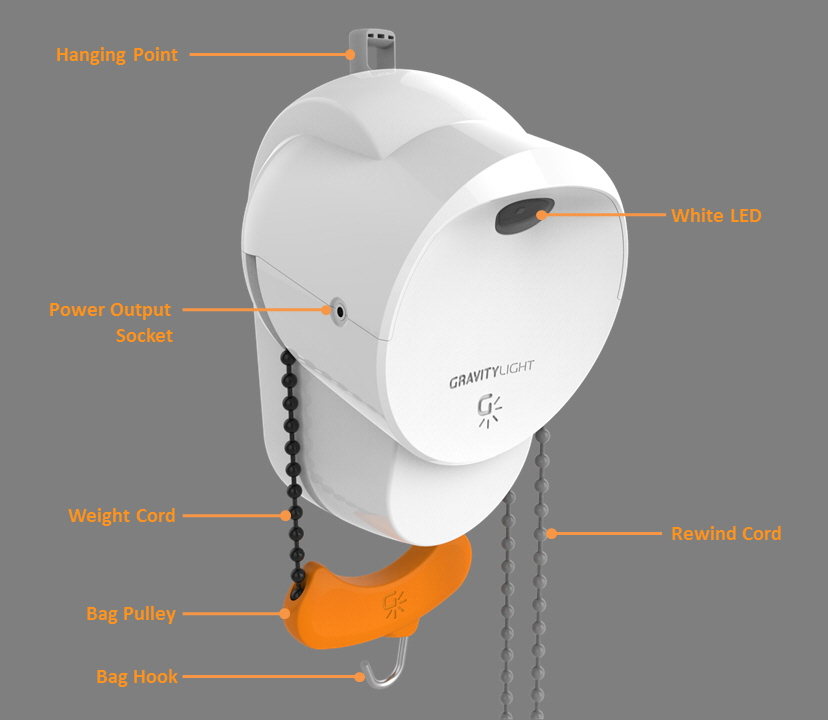
The result of this collaboration was the GravityLight, a gravity-powered LED lamp. Rather than relying on stored electrical energy, the device uses gravitational potential energy. A weight is lifted and then allowed to descend slowly, driving a small generator that powers an LED light.
How Gravity-Powered Lighting Works
Gravity-powered lighting systems convert the downward motion of a suspended weight into electrical energy. As the weight descends, it turns gears connected to a generator, producing enough power to illuminate an efficient LED for a fixed period of time. Once the weight reaches the bottom, it can be raised again to restore lighting.
This approach eliminates the need for batteries, which can be expensive, difficult to replace, or environmentally harmful when disposed of improperly. It also removes dependence on fuel sources such as kerosene, reducing both cost and health risks.
Impact and Broader Implications
Gravity-powered LED lighting demonstrates how simple physical principles can be applied to address real-world problems. While not intended to replace full electrical systems, solutions like GravityLight provide immediate benefits in environments where grid access is unavailable or unreliable.
Beyond lighting, projects like this highlight the importance of appropriate technology—solutions that are tailored to local conditions, economic realities, and long-term sustainability. These designs focus on reliability and ease of use rather than complexity.
For more information about GravityLight and its mission, visit: https://deciwatt.global/gravitylight
FAQ
Why are kerosene lamps dangerous?
Kerosene lamps pose fire risks and produce fumes that can cause long-term respiratory health problems.
How does a gravity-powered light generate electricity?
It converts the slow descent of a lifted weight into electrical energy using a small generator.
Does GravityLight require batteries or fuel?
No. It operates without batteries, fuel, or external electricity.


