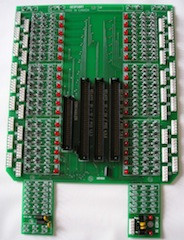


The RMOTHER family of remote control motherboards is used within the GE Lighting Total Lighting Control (TLC) system to provide the physical interconnection between relays, power supplies, field devices, and plug-in control electronics. RMOTHER boards function as termination and interconnection platforms rather than standalone controllers, forming the internal backbone of relay-based lighting automation panels.
Each RMOTHER model corresponds to a defined relay range and panel configuration. While the models differ in relay coverage and physical layout, they serve the same fundamental role within the TLC system: providing a structured motherboard that connects relay hardware and field wiring to the system’s control and intelligence cards.
RMOTHER Product Family Overview
RMOTHER boards are designed to be installed inside GE Lighting TLC panels, where they act as the main termination board for low-voltage relay switching systems. They provide connection points for relay cards, dataline communication, power distribution, and field-connected devices such as switches or sensors.
The RMOTHER family supports modular panel construction by allowing relay ranges to be segmented across different motherboard models. This modular approach simplifies panel layout, wiring organization, and service activities by clearly defining which relay groups are associated with each motherboard.
RMOTHER Model Descriptions
The following RMOTHER models are used within GE Lighting TLC systems. Each model supports a specific relay range and is installed as part of a larger lighting automation panel.
RMOTHER1
RMOTHER1 is a remote control motherboard used to support the first relay group within a GE Lighting TLC panel. It provides termination and interconnection for relays 1 through 24, along with associated power and control connections. RMOTHER1 serves as the foundational motherboard for the initial relay section of the panel.
RMOTHER2
RMOTHER2 is used to support the next relay group within the TLC system, typically covering relays 25 through 48. Like other RMOTHER boards, it functions as a termination and interconnection platform, extending relay capacity while maintaining consistent wiring and control interfaces within the panel.
RMOTHER3
RMOTHER3 is a remote control motherboard designed for additional relay sections within larger TLC installations. It follows the same functional role as other RMOTHER models, providing physical interconnection between relays, field wiring, and plug-in control electronics for its designated relay range.
RMOTHER4
RMOTHER4 is used in higher-capacity or expanded GE Lighting TLC panels where additional relay coverage is required. It continues the RMOTHER design approach by acting as a structured termination board that integrates relay hardware with the panel’s control and intelligence components.
Role Within GE Lighting TLC Panels
Across all models, RMOTHER boards share the same fundamental purpose: they do not provide lighting control logic themselves, but instead enable that logic by physically connecting relay outputs, field inputs, and control electronics within the panel. This separation of termination hardware from intelligence cards allows TLC systems to be built, expanded, and serviced using standardized components.
Understanding which RMOTHER model is installed in a given panel section helps technicians and integrators identify relay groupings, trace wiring, and assess panel configuration during maintenance or retrofit activities.
FAQ
What is the RMOTHER product family?
RMOTHER refers to a family of remote control motherboards used in GE Lighting TLC panels to provide physical interconnection between relays, power, field devices, and control electronics.
Do RMOTHER boards perform lighting control logic?
No. RMOTHER boards act as termination and interconnection platforms. Lighting control logic is handled by separate plug-in electronics or intelligence cards.
How do RMOTHER models differ from each other?
RMOTHER models differ primarily by the relay range and panel section they support. Functionally, they serve the same role within the TLC system.