Allen-Bradley's Data Highway An Overview
Data Highway Plus (DH+) is a legacy proprietary industrial network developed by Allen-Bradley (now Rockwell Automation) for peer-to-peer communication between PLCs and peripheral devices. It is architected as a modified token-passing local area network (LAN) designed to provide deterministic access to the network, which is critical for real-time industrial automation.
In many modern industrial environments, DH+ remains a vital link for legacy equipment, including the PLC-5 and SLC 500 families. Understanding its 57.6 Kb/s data rate and specialized baseband shielded twinaxial cable physical layer is essential for maintenance and protocol conversion projects.
Technical Architecture of DH+
The hallmark of Data Highway Plus is its deterministic nature. Unlike Ethernet (which traditionally uses CSMA/CD and can suffer from collisions), DH+ uses a modified token-passing scheme. In this protocol, a "token" is passed from node to node; only the node holding the token is permitted to transmit data. This ensures that every device on the network has a guaranteed window to communicate, preventing network saturation and unpredictable delays.
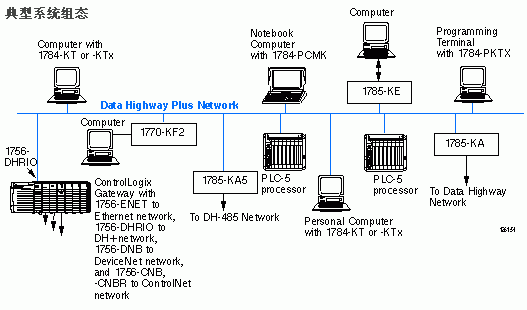
Physical Layer Specifications:
- Media: DH+ utilizes shielded twinaxial cable (commonly referred to as "Blue Hose" cable, such as Belden 9463).
- Signaling: It uses baseband signaling to transmit data across the twinaxial differential pair.
- Data Rates: While this overview focuses on the standard 57.6 Kb/s, the protocol also supports 115.2 Kb/s and 230.4 Kb/s depending on the hardware and cable length.
- Topology: Typically deployed in a trunkline/dropline configuration, requiring termination resistors (usually 82 or 150 ohms) at both ends of the main trunk to prevent signal reflection.
Integrating DH+ with Modern Networks
As facilities migrate toward EtherNet/IP and BACnet, the need to bridge legacy DH+ networks becomes a priority. Because DH+ is a proprietary protocol, it requires specialized hardware—such as the 1761-NET-AIC or third-party gateways—to translate peer-to-peer messages into modern packets.
Common Legacy Devices utilizing DH+:
- Allen-Bradley PLC-5: The primary platform for DH+ communications, often used as the "Master" node in legacy architectures.
- SLC 500: Utilizing the DH-485 to DH+ bridge or direct DH+ ports on specific models like the SLC 5/04.
- PanelView HMIs: Legacy operator terminals that relied on the deterministic speed of DH+ for real-time tag updates.
Modern protocol gateways allow these legacy controllers to appear as BACnet Objects or Modbus Registers, extending the life of the hardware without requiring a full rip-and-replace of the cabling infrastructure.
FAQ: Data Highway Plus (DH+)
1) What is the maximum distance for a DH+ network?
At the standard 57.6 Kb/s rate, a DH+ trunk line can extend up to 10,000 feet (3,048 meters). However, increasing the baud rate to 230.4 Kb/s significantly reduces the allowable distance to approximately 2,500 feet.
2) Is DH+ the same as DH-485?
No. While both are Allen-Bradley protocols, DH-485 is based on the RS-485 electrical standard, whereas DH+ uses a unique physical layer and transformer-coupled signaling. They are not directly compatible without a bridge.
3) Can I run DH+ on standard Ethernet cabling?
No. DH+ requires shielded twinaxial cable to handle the specific impedance and differential signaling of the modified token-passing protocol. Using Cat5e or Cat6 will result in high error rates and network failure.
4) How many nodes can exist on a single DH+ segment?
A single DH+ network can support up to 64 nodes, with addresses typically set in Octal (00-77).
Need a Gateway to Bridge DH+ to Ethernet or BACnet?
Chipkin provides expert-level gateways and diagnostic tools for Allen-Bradley protocol integration. Whether you are bridging PLC-5 systems or SLC 500 networks, we have the hardware you need: