MQTT to BACnet/IP Integration for a Multi-Building Smart Lighting System
 Case Study – MQTT to BACnet/IP Integration for a Multi-Building Smart Lighting System
Overview
A multi-building development relied on a custom smart lighting platform that published operating data over MQTT, while the site's central Building Management System required that information to be available over BACnet/IP.
The lighting system generated a large amount of useful data for each fixture, including brightness, occupancy, light levels, energy usage, emergency status, and fault conditions. Chipkin used a FieldServer QuickServer to subscribe to the MQTT data, organize the incoming values into a consistent structure, and expose them as standard BACnet objects that could be used by the central BMS.
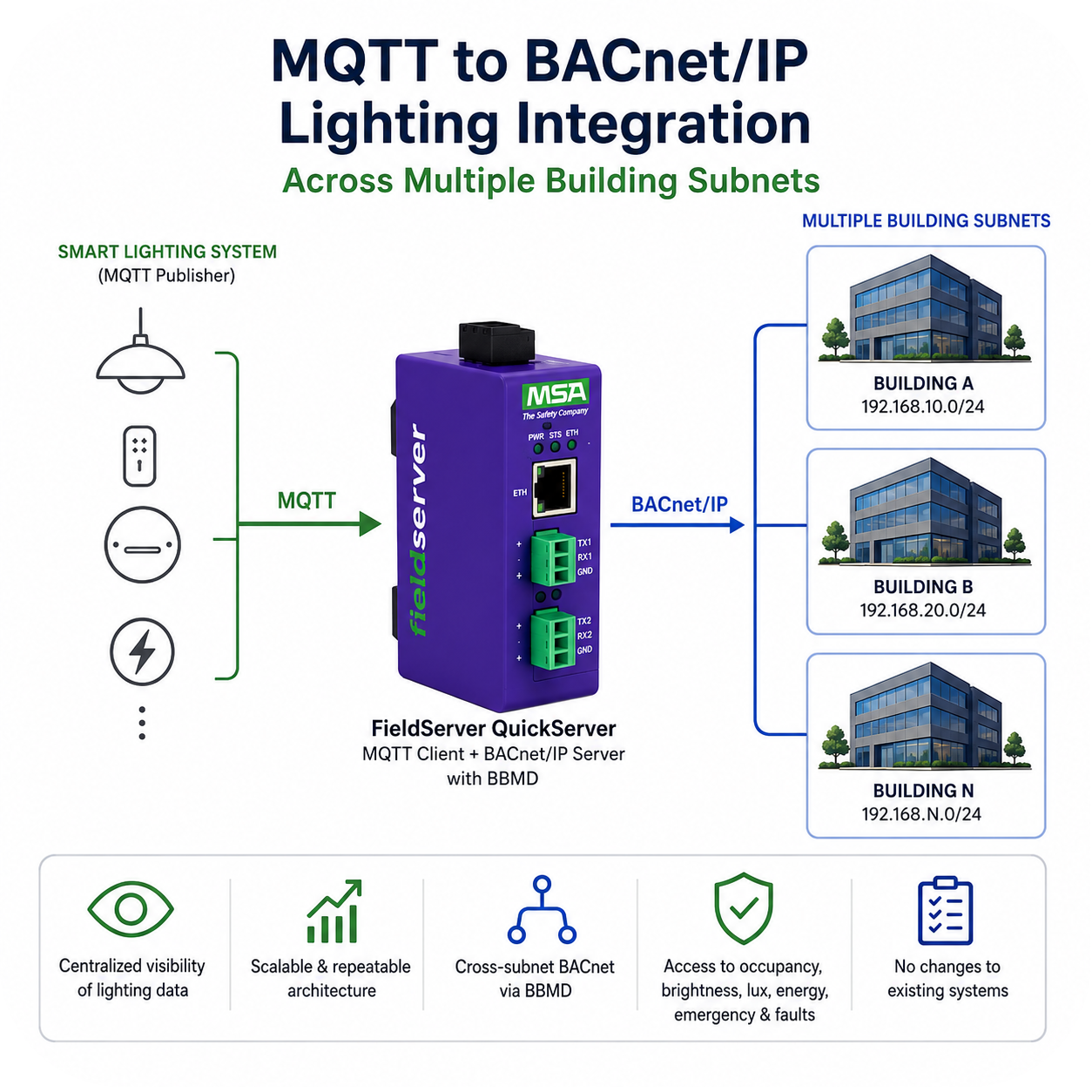
The integration also had to work across a segmented network, with each building operating on its own IP subnet and the central BMS located on a separate network. To enable BACnet communication across these routed subnets, Chipkin configured the QuickServer's built-in BACnet BBMD functionality, allowing the central BMS to discover and communicate with the lighting data from each building.
The result was a scalable MQTT-to-BACnet integration that gave the customer centralized access to lighting data from multiple buildings without replacing or modifying the existing lighting system.
The Challenge
The customer needed to integrate a custom smart lighting system into a central BACnet/IP BMS. Each lighting device published approximately 22 operating values over MQTT, including brightness, occupancy, lux levels, energy usage, emergency status, and fault conditions.
These MQTT values needed to be translated into a consistent BACnet object structure, with each lighting point assigned a predictable object type, instance, and naming convention. This was important because the central BMS needed to discover, identify, and use the data consistently across a large number of lighting devices.
The project also involved a multi-building network architecture. Each building operated on its own IP subnet, while the central BMS was located on a separate network. Although the BACnet objects were visible locally, they also needed to be discoverable and accessible across the routed network.
The integration therefore had two primary challenges:
- Convert a large number of MQTT lighting points into a structured, scalable BACnet object model.
- Enable the central BMS to discover and communicate with those BACnet objects across multiple IP subnets.
Chipkin's Approach to the Solution
Chipkin restructured the QuickServer configuration so that the lighting system's MQTT data could be mapped into a consistent and scalable BACnet/IP structure.
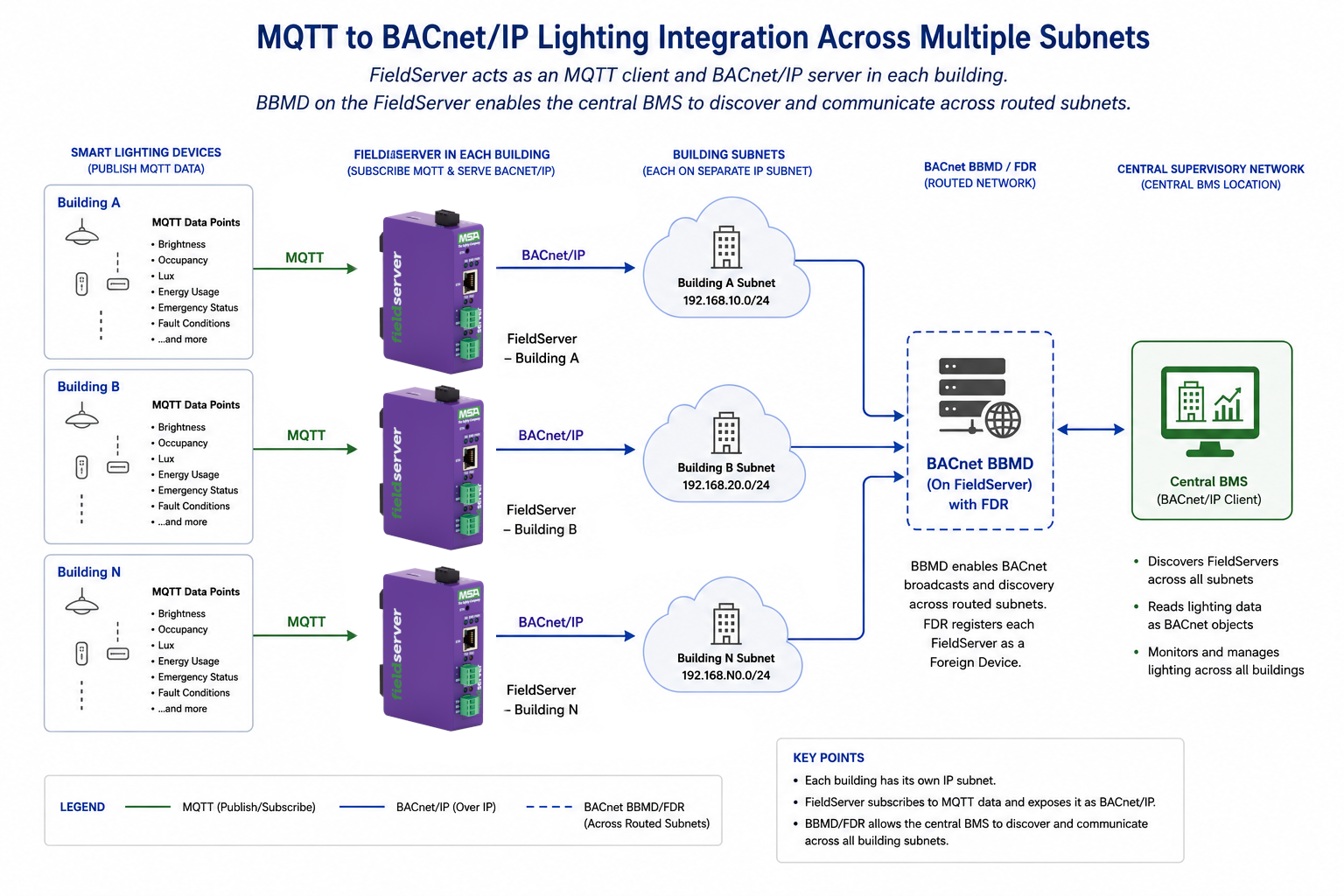
MQTT to BACnet/IP Multi-Building Network Architecture
Structured MQTT to BACnet Mapping
Each lighting device published approximately 22 MQTT data points, including brightness, occupancy, lux, energy usage, emergency status, and fault conditions. Rather than allowing multiple fixtures to share repeated Data Array locations, Chipkin organized the configuration using a consistent per-device structure.
Each MQTT topic was assigned a unique Data Array location and exposed as the corresponding BACnet object. The QuickServer subscribed to the MQTT topics, stored the incoming values in FieldServer Data Arrays, and served the resulting information over BACnet/IP.
This predictable structure also supported the customer's automated configuration-generation process as additional lighting devices were added.
Configuration Refinement
During testing, Chipkin identified several configuration issues, including repeated offsets and automatically generated names that exceeded FieldServer limits. The configuration was revised to use unique offsets, consistent point ordering, and compliant Data Array and Map Descriptor names.
Once corrected, the lighting endpoints appeared properly in the FieldServer interface and the Data Arrays populated with live data.
BACnet/IP Across Multiple Subnets
Because each building operated on a separate IP subnet, local BACnet discovery alone was not sufficient for the central BMS. Chipkin configured the QuickServer's BACnet BBMD functionality and coordinated it with the site's existing Foreign Device Registration (FDR) routing so BACnet discovery and communication could operate across the routed network.
This allowed the central supervisory system to discover and query the BACnet lighting data from each building across the segmented network.
Results & Customer Advantages
The completed integration made the smart lighting data available to the central BACnet supervisory system. The project team confirmed that the lighting endpoints populated correctly in the FieldServer and that the BACnet data could be discovered and queried across the separate building subnets.
Key benefits included:
- MQTT to BACnet/IP integration without modifying the existing lighting platform.
- Centralized visibility of lighting data from multiple buildings.
- Scalable, consistent point mapping for each lighting device.
- Cross-subnet BACnet communication using the QuickServer's BBMD functionality.
- A repeatable integration structure that can support future devices and buildings.
The project demonstrated how a FieldServer QuickServer can bridge an MQTT-based lighting system into a BACnet/IP environment while maintaining the site's existing network segmentation.
FAQ
Can MQTT devices be integrated with a BACnet/IP building management system? +
Yes. A FieldServer QuickServer can subscribe to MQTT data and expose the received values as standard BACnet/IP objects. This allows an MQTT-based lighting or IoT system to provide data to a BACnet BMS without replacing the existing field devices or application.
How does a FieldServer QuickServer convert MQTT data to BACnet/IP? +
The QuickServer subscribes to configured MQTT topics and stores the incoming values in FieldServer Data Arrays. Those values are then mapped to BACnet objects that can be discovered and read by a BACnet/IP supervisory system.
Can BACnet/IP devices communicate across different IP subnets? +
Yes, but BACnet broadcast traffic normally does not pass through IP routers automatically. In this project, the QuickServer's BACnet BBMD functionality was configured so the central BMS could discover and communicate with BACnet devices across the site's routed building networks.
What is a BACnet BBMD and why is it needed? +
A BACnet Broadcast Management Device, or BBMD, distributes BACnet broadcast messages between different IP subnets. It is commonly required on campuses and multi-building systems where BACnet devices and supervisory systems are located on separate routed networks.
Can MQTT-to-BACnet integration scale to many lighting devices? +
Yes. Using a consistent per-device mapping structure allows MQTT topics to be organized into predictable BACnet objects as additional devices are added. In this project, each lighting device provided approximately 22 data points, including brightness, occupancy, lux, energy, emergency status, and fault information.