Integrating Tecogen Energy Systems with SkySpark Analytics BMS
 Case Study – Integrating Tecogen Energy Systems with SkySpark Analytics BMS
Please CONTACT US for questions
Case Study – Integrating Tecogen Energy Systems with SkySpark Analytics BMS
Please CONTACT US for questions
Overview
At a glance:
- Commercial hospitality facility (hotel)
- Tecogen generators, chiller, and metering equipment integrated
- Modbus RTU → Modbus TCP protocol conversion
- Successful delivery of normalized data to SkySpark BMS
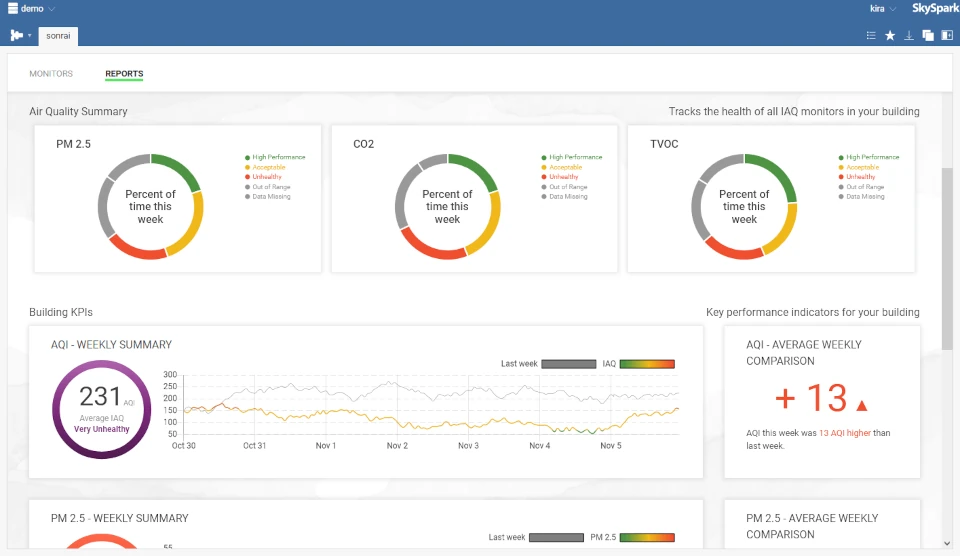
DSM Engineering Associates required a reliable method to integrate on-site Tecogen InVerde e+ cogeneration units, a U1000FM ultrasonic flow meter, Veris E50 electrical energy meters, and a Tecochill DTx Series 300 water-cooled chiller at a high-occupancy hotel in New York City into a SkySpark analytics platform. The installed equipment communicated using Modbus RTU, while the analytics environment required Modbus TCP for real-time monitoring and energy analysis.
A Chipkin QuickServer Modbus RTU to Modbus TCP gateway was deployed to bridge the two systems without modifying or replacing any field equipment. The solution delivered stable, validated, and normalized data into the analytics platform, enabling accurate energy visibility and supporting long-term operational optimization.
Customer Goals and Challenges
Our client was tasked with improving energy visibility and performance analytics for a high-occupancy hotel in New York City. The goal was to deliver reliable, real-time operational data from on-site energy systems into a SkySpark analytics environment to support monitoring, analysis, and long-term optimization. See the network diagram below.
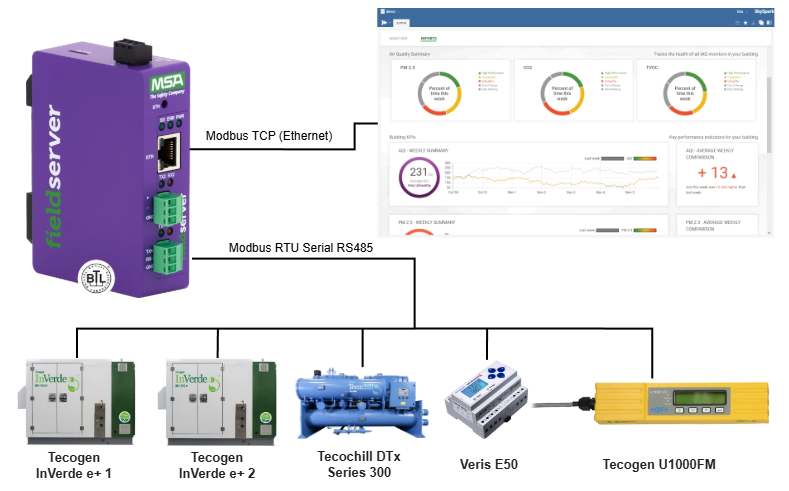
The primary challenge was that the installed Tecogen cogeneration, chiller, and metering equipment communicated exclusively using Modbus RTU, while the analytics platform required Modbus TCP. Replacing or modifying live equipment was not an option, and the solution needed to integrate cleanly with existing systems already operating in the facility.
Additional technical challenges included:
- Integrating into an active Modbus RTU network without disrupting live operations
- Supporting a multi-master RS-485 architecture
- Ensuring accurate register mapping, scaling, and data normalization
- Delivering stable, trustworthy data suitable for analytics and decision-making
The solution needed to be reliable, non-intrusive, and scalable, meeting both immediate project requirements and long-term operational goals.
Chipkin’s approach to the solution
Chipkin approached the integration by first validating the existing Modbus RTU environment to ensure the new gateway could be introduced without impacting live systems. Serial communication parameters—including baud rate, parity, and stop bits—were verified to align with the installed Tecogen equipment and existing Modbus masters.
Because the existing RS-485 network was already controlled by a Tecogen Modbus RTU master, connecting the QuickServer as a second master directly to the same bus created a multi-master conflict. An ICP DAS TSH-735 Modbus splitter was therefore introduced to isolate the two masters and allow both systems to independently communicate with the Modbus devices without bus contention.
All data points were carefully validated, scaled, and normalized within the gateway before being exposed as Modbus TCP to the SkySpark environment. This ensured that values were accurate, stable, and immediately usable for analytics and energy performance evaluation.
By combining protocol expertise with practical field engineering, Chipkin delivered a robust, non-intrusive integration that met both immediate project needs and long-term operational requirements.
Results and Key Takeaway
The completed integration delivered reliable, real-time access to operational data from Tecogen cogeneration, chiller, and metering systems into the SkySpark analytics environment. Data was validated, normalized, and consistently available without disrupting existing equipment or live operations.
As a result, the client gained improved visibility into energy production, cooling performance, and consumption across the facility. This enabled more accurate analytics, reduced reliance on manual data collection, and supported better-informed operational decisions for a mission-critical hospitality site.
Key outcomes
- Stable delivery of normalized Modbus TCP data to SkySpark
- Accurate, analytics-ready energy and performance data
- Improved operational insight without equipment replacement
- Reduced integration risk through a proven, non-intrusive architecture
- A scalable solution supporting future optimization initiatives
FAQ
Why was a Modbus RTU to Modbus TCP gateway required for this project? +
The installed Tecogen equipment—including the InVerde e+ cogeneration units, Tecochill chiller, and metering devices—communicated using Modbus RTU over RS-485. The SkySpark analytics platform required Modbus TCP over Ethernet to ingest operational data. The QuickServer gateway converted Modbus RTU data into Modbus TCP without requiring changes to the existing equipment or control infrastructure.
What equipment was integrated in this project? +
The integration included multiple Modbus RTU devices operating on a shared RS-485 network. These included Tecogen InVerde e+ cogeneration units, a Tecogen U1000FM ultrasonic flow meter, Veris E50 electrical energy meters, and a Tecochill DTx Series 300 water-cooled engine-driven chiller. Data from these systems was collected and delivered to the SkySpark analytics platform for monitoring and analysis.
How was a multi-master RS-485 Modbus RTU network supported? +
The existing RS-485 network already contained a Modbus master polling the Tecogen equipment. To allow the QuickServer gateway to collect the same data without disrupting operations, an ICP DAS RS-485 Modbus splitter was implemented. This maintained protocol integrity and prevented bus contention while allowing multiple masters to coexist on the network.
What role did SkySpark play in the integration? +
SkySpark served as the building analytics platform for the project. By receiving normalized Modbus TCP data from the QuickServer gateway, SkySpark could perform energy analytics, equipment monitoring, and performance optimization across the hotel's energy systems.
Can Chipkin integrate other Modbus RTU energy systems into analytics platforms? +
Yes. Chipkin regularly integrates Modbus RTU devices such as generators, meters, chillers, and industrial controllers into modern building management systems, analytics platforms, and cloud monitoring environments using protocol gateways and custom drivers. These integrations allow legacy equipment to participate in modern energy management and optimization workflows.