Veeder-Root TLS450+ Fuel System Integration Using Modbus TCP
 Case Study – Veeder-Root TLS450+ Fuel System Integration Using Modbus TCP
Please CONTACT US for questions
Case Study – Veeder-Root TLS450+ Fuel System Integration Using Modbus TCP
Please CONTACT US for questions
Overview
BAE Systems, Inc., a large industrial defense organization, required reliable, real-time access to fuel inventory, alarm, and sensor data from two Veeder-Root TLS450+ fuel management systems, each monitoring two underground storage tanks, within a Modbus TCP supervisory environment.
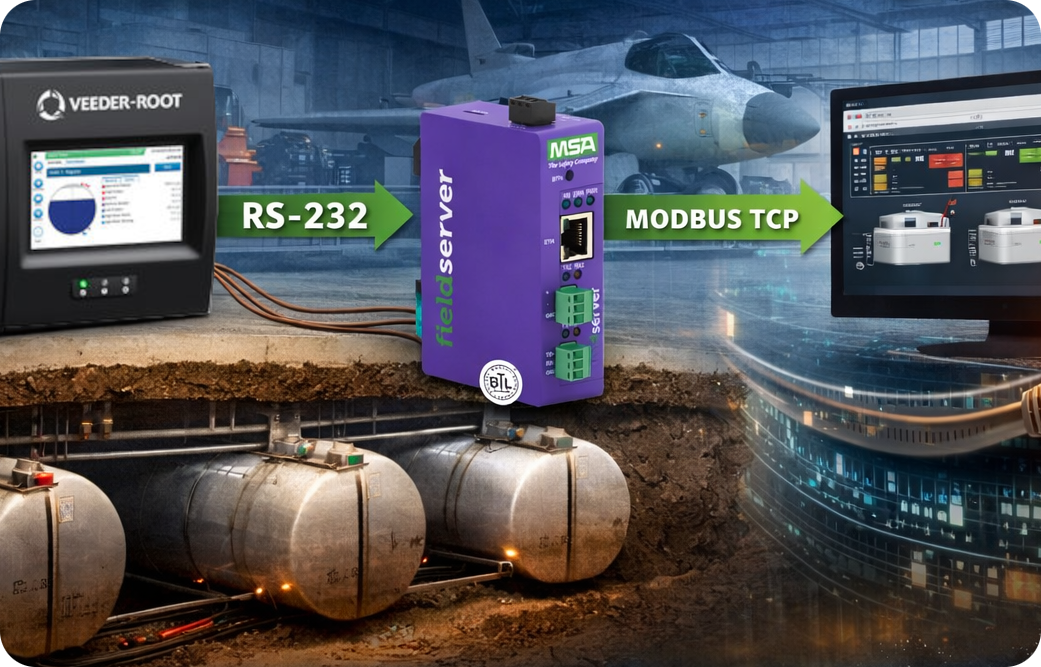
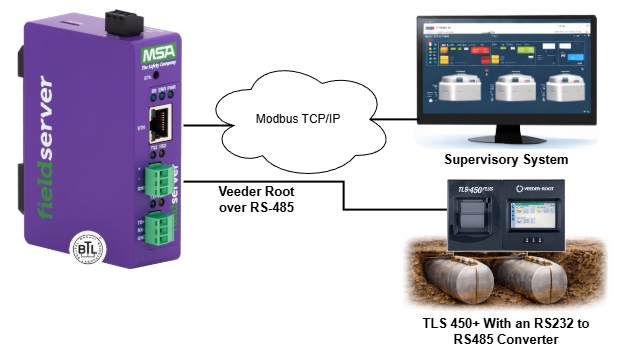
The TLS450+ communicates using Veeder-Root’s proprietary RS-232 serial protocol. To support the site’s long-distance installation, an RS-232 to RS-485 converter was installed at each TLS panel, allowing data to be transmitted over long RS-485 cable runs to the integration point.
Using FieldServer QuickServer gateways, Chipkin Automation Systems implemented a protocol conversion solution that exposed Veeder-Root fuel system data as Modbus TCP registers. The deployment supported hundreds of data points and delivered stable, continuous data suitable for mission-critical fuel operations—without replacing existing fuel management equipment.
Customer Goals and Challenges
The customer operates fuel infrastructure supporting mission-critical industrial and defense operations. Their objective was to make fuel inventory, temperature, alarm, and sensor data from the Veeder-Root TLS450+ fuel management systems available to centralized supervisory and monitoring systems.
While the TLS450+ consoles provided reliable local monitoring, they communicated using Veeder-Root’s proprietary RS-232 serial protocol, preventing direct integration with the client’s Modbus TCP–based architecture.
Customer Goals
- Provide centralized visibility into fuel inventory and alarm conditions
- Integrate fuel system data into existing Modbus TCP supervisory systems
- Preserve certified Veeder-Root fuel management equipment
- Avoid replacement of underground tanks, sensors, or console hardware
- Ensure long-term reliability suitable for mission-critical operations
Key Challenges
- The Veeder-Root TLS450+ required protocol-level integration using its proprietary RS-232 interface
- RS-232 to RS-485 conversion was required to support long-distance cabling between the TLS panels and the gateways
- Long-distance RS-485 cabling introduced physical-layer risks affecting communication stability
- Fuel system data required accurate modeling and mapping into Modbus registers
These challenges required a robust protocol gateway solution capable of reliably bridging certified fuel monitoring systems into a modern supervisory environment.
Chipkin’s approach to the solution
Chipkin approached the integration as a system-level problem, addressing protocol behavior, data modeling, and field conditions rather than treating it as a simple serial conversion.
A FieldServer QuickServer gateway was configured to communicate with the Veeder-Root TLS450+ using Veeder-Root’s proprietary RS-232 serial protocol, converted to RS-485 via RS-232 to RS-485 converters at the TLS panels for long-distance communication. Fuel system data was then exposed as Modbus TCP registers to upstream supervisory systems.
Key aspects of the solution included:
- Configuring protocol-level communication to reliably extract inventory, alarm, relay, and sensor data
- Mapping hundreds of fuel system data points into a clear, SCADA-friendly Modbus register model
- Designing the gateway configuration to support high point counts without degrading performance
- Validating field behavior against known-good test conditions to identify and resolve serial communication issues
By addressing both protocol and physical-layer considerations, Chipkin delivered a stable, maintainable integration suitable for mission-critical fuel monitoring.
Results and Key Takeaway
The completed integration provided reliable, real-time access to fuel inventory, alarms, and sensor data from two Veeder-Root TLS450+ systems, each monitoring two underground storage tanks. Fuel system data was transmitted from the TLS consoles over RS-232, converted to RS-485 for long-distance communication, and delivered to supervisory systems over Modbus TCP via FieldServer QuickServer gateways.
Key results included:
- Stable, continuous Modbus TCP data from the Veeder-Root fuel management systems
- Reliable long-distance serial communication using an RS-232 to RS-485 architecture
- Centralized visibility of fuel inventory, alarms, and sensor status
- Preservation of certified Veeder-Root equipment and existing infrastructure
- No replacement of underground tanks, sensors, or fuel management consoles
Veeder-Root integrations require protocol-level expertise and careful consideration of serial communication architecture. When RS-232 systems are extended using RS-485 for long-distance installations, physical-layer behavior becomes as critical as protocol configuration. With proper gateway selection, data modeling, and field validation, certified fuel monitoring systems can be reliably integrated into modern supervisory architectures without disrupting existing installations.
FAQ
Can a Veeder-Root TLS450+ communicate directly using Modbus TCP? +
No. The Veeder-Root TLS450+ uses a proprietary serial protocol over RS-232. A protocol gateway such as a FieldServer QuickServer is required to convert this data to Modbus TCP for integration with supervisory systems.
Why was RS-232 converted to RS-485 in this project? +
RS-232 is limited in distance and is not suitable for long cable runs. In this installation, RS-232 was converted to RS-485 at the TLS panels to support reliable long-distance communication to the gateways.
How many tanks were monitored in this project? +
The project integrated two Veeder-Root TLS450+ fuel management systems. Each TLS450+ monitored two underground storage tanks, for a total of four tanks.
What type of data was exposed to Modbus TCP? +
Fuel inventory, temperature, alarm, relay, and sensor data were made available to centralized supervisory and monitoring systems using Modbus TCP.
Did the integration require replacement of existing fuel infrastructure? +
No. The solution preserved the existing certified Veeder-Root equipment and infrastructure, including the underground tanks, sensors, and fuel management consoles.