Manually Adding a BACnet Device Across a Subnet Using CAS BACnet Explorer
 CAS BACnet Explorer:
Available as a free tool for discovering, browsing, and testing BACnet devices.
CAS BACnet Explorer:
Available as a free tool for discovering, browsing, and testing BACnet devices.
BACnet device discovery commonly relies on broadcast messages such as Who-Is and I-Am. When devices are located on different IP subnets, these broadcasts may not pass through routers, making automatic discovery unreliable or impossible. In these cases, CAS BACnet Explorer allows devices to be added manually, provided the necessary device information is known in advance.
Manually adding a device does not bypass BACnet communication rules. It simply allows the tool to attempt direct, unicast communication with a known BACnet device address. Successful communication still depends on correct addressing, routing, and network configuration.
Prerequisites for Manual Device Addition
Before manually adding a BACnet device across a subnet, the following information must be known accurately:
- Network type (BACnet/IP, BACnet MS/TP, etc.)
- Device instance number
- IP address or MAC address of the device
- Network number, if applicable
Manual addition does not guarantee connectivity. It only provides CAS BACnet Explorer with enough information to attempt communication using direct BACnet services.
Steps to Manually Add a Device
- Start CAS BACnet Explorer.
- Click the Discover button on the main application window to open the Discovery dialog.
- Select Manually Add Device/Object. The Add Object dialog will appear.
-
Enter the known information for the BACnet device or object, then click Add.
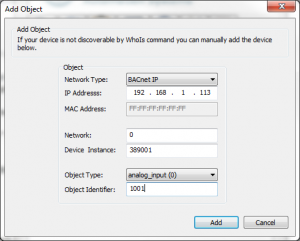
- The device or object will appear in the CAS BACnet Explorer tree. At this stage, no communication has yet occurred.
- Right-click the newly added device and select Discover from the context menu.
- Ensure Discover device properties and Discover objects are selected, then click Send.
Interpreting Discovery Results
If CAS BACnet Explorer successfully communicates with the device, the device profile will populate with its supported objects and properties. This confirms that routing and addressing are functioning correctly.
If the error message Err #1: request timed out appears, the device did not respond to the direct BACnet request.
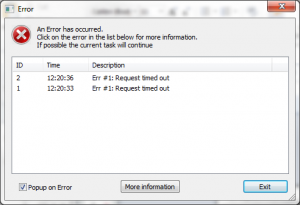
A timeout may indicate incorrect addressing, missing BACnet routing, firewall restrictions, or that the device is offline.
BACnet Explorer Manual Device Addition FAQ
Why is manual device addition required across subnets?
BACnet broadcast messages often do not traverse routers. Manual addition allows unicast communication
when broadcast discovery is blocked.
Does manually adding a device guarantee connectivity?
No. Manual addition only supplies addressing information. Communication still depends on correct
routing, network configuration, and device availability.
What does a timeout error indicate?
A timeout means the device did not respond to a BACnet request. Common causes include incorrect IP
address, wrong device instance, missing BACnet router configuration, or firewall blocking.
Can this method be used with BACnet/IP routers?
Yes, provided the router is correctly configured and the target device is reachable using unicast
BACnet communication.
Does CAS BACnet Explorer bypass BACnet network rules?
No. CAS BACnet Explorer follows standard BACnet communication behavior and does not bypass routing or
security restrictions.