CAS BACnet Explorer - Broadcast traffic
 CAS BACnet Explorer:
Available as a free tool for discovering, browsing, and testing BACnet devices.
CAS BACnet Explorer:
Available as a free tool for discovering, browsing, and testing BACnet devices.
BACnet/IP discovery commonly relies on broadcast traffic. Many enterprise and segmented building networks block broadcasts by design to reduce noise, limit propagation across VLANs, and improve overall security. When broadcasts are filtered, BACnet tools that depend on broadcast discovery may not automatically find devices on the network.
This article explains what happens when broadcast traffic is blocked, what functionality is affected in CAS BACnet Explorer, and how to continue working by manually defining devices and objects. The intent is to provide a clear operational explanation that remains valid even without screenshots or additional context.
Question
Broadcast traffic is being blocked on my network. Can I still use CAS BACnet Explorer?
Answer
Yes, but with restrictions. The primary limitation is device discovery.
BACnet discovery typically uses the standard BACnet services Who-Is and I-Am. In many BACnet/IP deployments, Who-Is is sent as a broadcast and devices respond with I-Am messages. If your network blocks broadcasts, CAS BACnet Explorer may not be able to perform the initial discovery step that automatically populates devices and objects.
Once a device (and optionally its objects) is already known to CAS BACnet Explorer, ongoing communication does not necessarily require broadcast traffic. Many normal operations can be performed using unicast traffic, including reading properties, writing properties (if permitted by the device), and requesting an object list.
What Still Works Without Broadcasts
If broadcasts are blocked, you can still use CAS BACnet Explorer for direct (unicast) communication to a BACnet/IP device, provided you know how to reach it on the network and the device accepts the requests. Typical operations that may still work include:
- Reading BACnet object properties via standard BACnet services (e.g., ReadProperty).
- Writing BACnet object properties where access is allowed (e.g., WriteProperty).
- Polling for an object list and browsing objects after the device is defined.
The key requirement is that the target device must already be identified and reachable by IP address (or by another addressing method supported by your configuration). Broadcast-based auto-discovery is the primary feature impacted by broadcast filtering.
How to Proceed: Manual Device and Object Entry
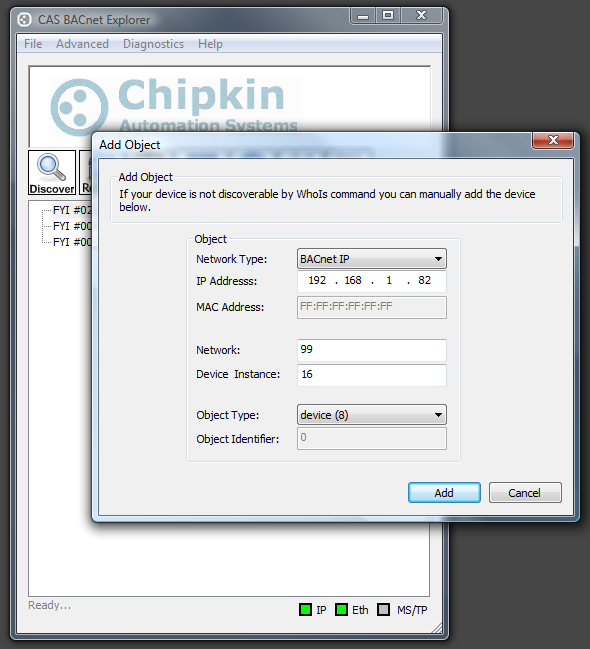
CAS BACnet Explorer allows you to add BACnet devices and objects manually from the discovery dialog. This is the standard workaround when Who-Is/I-Am broadcasts are not available. Manual entry requires that you know some of the device and network parameters in advance.
Depending on the network type and target, you may need the following information:
- Network type (for example, BACnet/IP).
- IP address (or other addressing details used by the device).
- Network number (when routing is involved).
- Device instance (BACnet Device Object identifier).
- Object type and object identifier (if adding objects directly).
After manually adding the device, you can use unicast requests to browse and interact with the device and its objects, subject to the device’s access control and network reachability.
FAQ
Why does BACnet discovery rely on broadcasts?
Who-Is is often broadcast so that all devices on a local BACnet/IP subnet can receive it and respond with
I-Am. This avoids needing to know device addresses in advance.
If broadcasts are blocked, can I still read and write properties?
Often yes. After a device is defined in the tool, many BACnet services can be sent using unicast traffic,
assuming routing and firewall rules allow communication and the device permits access.
What information do I need to add a device manually?
At minimum, you typically need the network type and a reachable address (e.g., IP address) plus the device
instance. Additional information may be required in routed environments.
Does this affect BACnet MS/TP the same way?
This article is specific to BACnet/IP broadcasts. MS/TP uses token passing on an RS-485 trunk and does not
use IP broadcast traffic in the same way.
Comment (Historical)
A 2011 comment requested the ability to register as a BACnet foreign device to enable discovery across network segments. This is a common requirement in routed BACnet/IP designs where broadcasts do not traverse subnets. If your environment spans multiple IP segments, discovery typically requires either BBMD configuration or a discovery strategy that does not depend on local broadcasts.