Comparing IPv4, IPv6, and Gigabit Ethernet: A Comprehensive Analysis
IPv4, IPv6, and Gigabit Ethernet are often mentioned together when discussing modern networks, but they operate at different layers of the networking stack and serve distinct purposes. Understanding how these technologies relate to each other is important when designing, configuring, or troubleshooting building automation and industrial control networks.
IPv4 and IPv6 are part of the Internet Protocol (IP) family and are responsible for logical addressing and routing of data between devices. Gigabit Ethernet, by contrast, defines how data is physically transmitted over wired Ethernet networks at high speed. While they work together in practice, they are not interchangeable technologies.
The sections below explain the role of each technology and how they interact within a typical TCP/IP networking environment.
What Is the Internet Protocol?
The Internet Protocol (IP) is a core component of the TCP/IP protocol suite. Its primary purpose is to provide logical addressing and packet routing so that data can be delivered from a source device to a destination device across one or more networks.
IP does not define how data is physically transmitted on a wire. Instead, it specifies how packets are addressed, fragmented if necessary, routed through intermediate devices, and reassembled at the destination.
IP operates above the data link and physical layers and relies on underlying technologies, such as Ethernet, to move packets from one node to another on a local network.
IPv4 and IPv6 Addressing
IPv4 and IPv6 are two versions of the Internet Protocol that differ primarily in address size and addressing capacity.
IPv4 uses 32-bit addresses, typically written in dotted decimal notation (for example, 192.168.1.10). This provides approximately 4.3 billion unique addresses, which has proven insufficient for long-term global growth without techniques such as Network Address Translation (NAT).
IPv6 uses 128-bit addresses, written in hexadecimal notation. This vastly expands the available address space and simplifies network design by reducing the need for address sharing and complex translation mechanisms.
Both IPv4 and IPv6 serve the same functional role: identifying devices and enabling packet routing across IP networks. They are protocol-layer technologies and are independent of the physical transmission speed or media.
What Is Gigabit Ethernet?
Gigabit Ethernet is an Ethernet standard that defines data transmission at a rate of 1 gigabit per second. It operates at the physical and data link layers of the OSI model and specifies how frames are encoded, transmitted, and received over Ethernet media.
Gigabit Ethernet does not assign IP addresses and does not perform routing. Instead, it provides the high-speed transport mechanism that allows higher-layer protocols, such as IP, to exchange data efficiently on a local area network.
Ethernet standards, including Gigabit Ethernet, define aspects such as signaling, cabling, frame format, and error detection. IP packets are encapsulated inside Ethernet frames when transmitted on a local network.
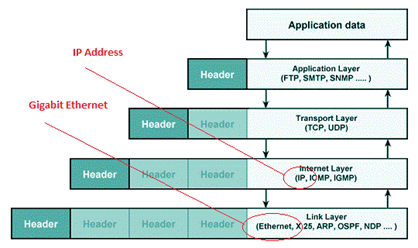
The diagram above illustrates how Ethernet and IP operate at different layers within the TCP/IP protocol suite.
How These Technologies Work Together
In a typical network, Gigabit Ethernet provides the physical connection between devices on the same local network. IPv4 or IPv6 operates above Ethernet to identify devices and route traffic beyond the local segment if required.
For example, a BACnet/IP device may use Gigabit Ethernet to physically connect to a switch, while IPv4 or IPv6 addressing is used to identify the device and exchange application data across the network. Ethernet delivers the frames locally; IP ensures that packets reach the correct destination.
Understanding this separation of responsibilities helps avoid common misconceptions, such as treating IP versions and Ethernet speeds as competing technologies. Each serves a different role within the overall networking stack.
Related Articles


