Advantages and Disadvantages of KNX
KNX Protocol - 10-Minute Course
Advantages and Disadvantages of KNX
KNX is a standardized building automation protocol that has been deployed globally in both residential and commercial environments. Like any technology, it has strengths and limitations. This page expands on commonly cited advantages and disadvantages to provide additional technical context while preserving the original lists.
Potential Advantages of KNX
Potential Advantages:
- Decentralized Network Structure
- Independent on the platform
- Low energy consumption
- Open standard
- Millions of installed devices
- Developed specifically for building automation
- Standardized applications assure consistency regardless of vendor
- Supported by hundreds of manufacturers
- Tree topology appropriate for large networks
- Choice of transmission media
- Backward compatible with former European Installation Bus (EIB)
The decentralized nature of KNX means that intelligence is distributed across devices rather than relying on a single central controller. This can improve system robustness and reduce single points of failure.
Being platform-independent and defined as an open standard allows devices from different manufacturers to coexist on the same network. Standardized applications help ensure that similar device functions behave consistently across vendors.
KNX also supports multiple transmission media (such as twisted pair, powerline, RF, and IP), allowing it to be deployed in both new constructions and retrofit projects. Its long history and large installed base contribute to ecosystem stability and long-term availability.
Some Disadvantages of KNX
Some Disadvantages:
- Community is relatively small (at least in the Western World -> more popular in Europe)
- Still unpopular amongst "home hackers" that like to develop own stuff (might change in the future due to the hardware independency)
Compared to some IP-based or consumer-oriented automation platforms, KNX has a smaller developer and hobbyist community, particularly outside of Europe. This can make informal learning resources and experimental projects less common.
KNX systems often rely on certified tools and formal configuration workflows, which can be a barrier for users who prefer rapid prototyping or custom development without specialized software.
Security Model
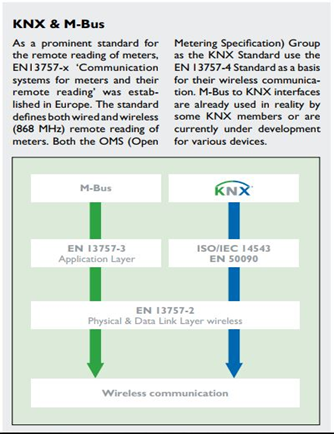
Image source: https://www.knx.org/media/docs/Flyers/Smart-Metering-With-KNX/Smart-Metering-With-KNX_en.pdf
FAQ: Advantages and Disadvantages of KNX
Why is KNX considered a decentralized system?
KNX distributes control logic across individual devices rather than relying on a single central controller, which can improve system resilience.
Is KNX a vendor-neutral protocol?
KNX is an open standard and is supported by hundreds of manufacturers, allowing multi-vendor systems.
Why is KNX more popular in Europe than in North America?
KNX has historical roots in Europe and has seen broader adoption there, resulting in a larger regional installer and integrator ecosystem.
Is KNX suitable for large buildings?
The protocol supports tree topology and large network structures, making it appropriate for large-scale building automation deployments.
Why might hobbyists find KNX less approachable?
KNX often requires specialized tools and formal configuration processes, which can be less appealing to users who prefer open-ended experimentation.


