VGA Connection Connector Overview
General Connectors Overview
This page provides an overview of the VGA (Video Graphics Array) connector, a long-standing analog video interface commonly found on legacy computers, industrial equipment, projectors, and building automation systems.
Although newer digital standards such as HDMI and DisplayPort have largely replaced VGA in consumer electronics, VGA remains widely used in environments where long equipment lifecycles and backward compatibility are required.
What is a VGA Connector?
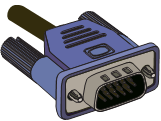
VGA is an analog video interface originally introduced by IBM in 1987. It uses a 15-pin, three-row DE-15 connector to transmit red, green, and blue (RGB) video signals along with horizontal and vertical synchronization.
Because VGA is analog, signal quality is affected by cable length, shielding, and electrical noise. Despite this limitation, it remains reliable for many legacy and industrial applications.
The table below outlines the physical characteristics, supported resolutions, and common uses of standard VGA and Mini-VGA connectors.
|
VGA |
||
| Name |
VGA (15-Pin) D-sub-miniature (D-sub) |
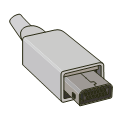
Mini-VGA (14-Pin) |
| Info | Function | |
| Video – Analog | ||
| Supported Resolutions | ||
|
640 x 480 (VGA) 800 x 600 (SVGA) 1024 x 768 (XGA) 1600 x 1200 (UXGA) 2048 x 1536 (QXGA) |
||
| Common Uses | ||
|
Video projectors Older laptops and monitors Power Mac G4 |
iMac (2002–2004) iBook G3 / G4 PowerBook G4 |
|
| Male |
|
|
| Female |

|

|
Practical Considerations
When using VGA in modern or industrial environments, cable quality and installation practices are critical. Poor shielding or excessive cable length can introduce ghosting, blur, or color distortion.
For new installations, digital interfaces are recommended. However, VGA remains a practical and widely supported solution for maintaining legacy systems.
Frequently Asked Questions
Is VGA still relevant today?
Yes. VGA is still commonly used in industrial, automation, and legacy systems where long-term compatibility is required.
Does VGA support audio?
No. VGA carries video only. Audio must be transmitted separately.
Can VGA be converted to HDMI or DVI?
Yes, but conversion requires active adapters because VGA is analog and HDMI/DVI are digital.