KNX Security Model Explained
KNX Protocol - 10-Minute Course
Security is an important consideration in building automation systems, particularly as control networks become increasingly connected to IP infrastructure and remote access solutions. The KNX Security Model defines how communication within a KNX system can be protected against unauthorized access, message manipulation, and eavesdropping.
KNX security is designed as a layered model. Rather than relying on a single protection mechanism, security features can be applied at different points in the system depending on the communication medium and system architecture. This allows integrators to apply appropriate protection while maintaining interoperability and predictable system behavior.
As shown in the diagram below, KNX security mechanisms include encrypted telegrams, authentication of communicating devices, and secure IP-based communication using KNX IP Secure.
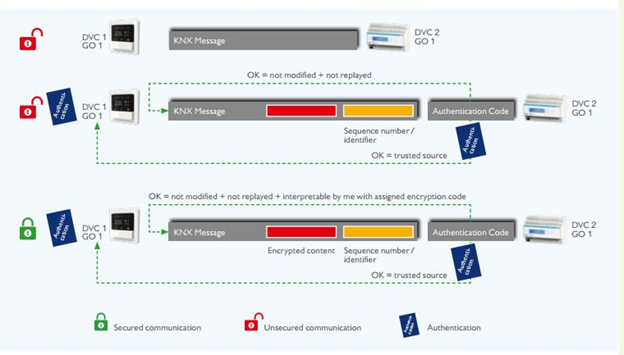
Fig: Overview of KNX Security
Core Elements of KNX Security
One element of the KNX Security Model is the use of encrypted telegrams. These telegrams are protected using standardized cryptographic algorithms to ensure that the content of messages cannot be interpreted by unauthorized devices on the network.
Authentication codes may also be used to verify that a message originates from a trusted source. This prevents unauthorized devices from injecting control commands or status updates into the KNX system.
For IP-based communication, KNX IP Secure extends the KNXnet/IP protocol to include security features suitable for Ethernet networks. This is particularly relevant when KNX traffic is routed across shared IP infrastructure or exposed to wider network segments.
Configuration and management of KNX security settings is typically performed using the ETS (Engineering Tool Software). ETS is used to assign keys, manage security parameters, and ensure consistent configuration across devices participating in secure communication.
FAQ: KNX Security Model
What is the KNX Security Model?
The KNX Security Model describes the mechanisms available within KNX to protect communication, including
encryption, authentication, and secure IP-based transport.
Does KNX support encrypted communication?
Yes. KNX supports encrypted telegrams that protect message content from being read or altered by unauthorized
devices.
What is KNX IP Secure?
KNX IP Secure is an extension of the KNXnet/IP protocol that adds security features for KNX communication over
Ethernet and IP networks.
How are KNX security settings configured?
Security configuration is managed through ETS, which is used to assign keys, enable security features, and
maintain consistent configuration across KNX devices.
Is KNX security mandatory for all installations?
No. KNX security features are applied based on system requirements. Integrators may choose which security
mechanisms to enable depending on risk, network exposure, and operational needs.


